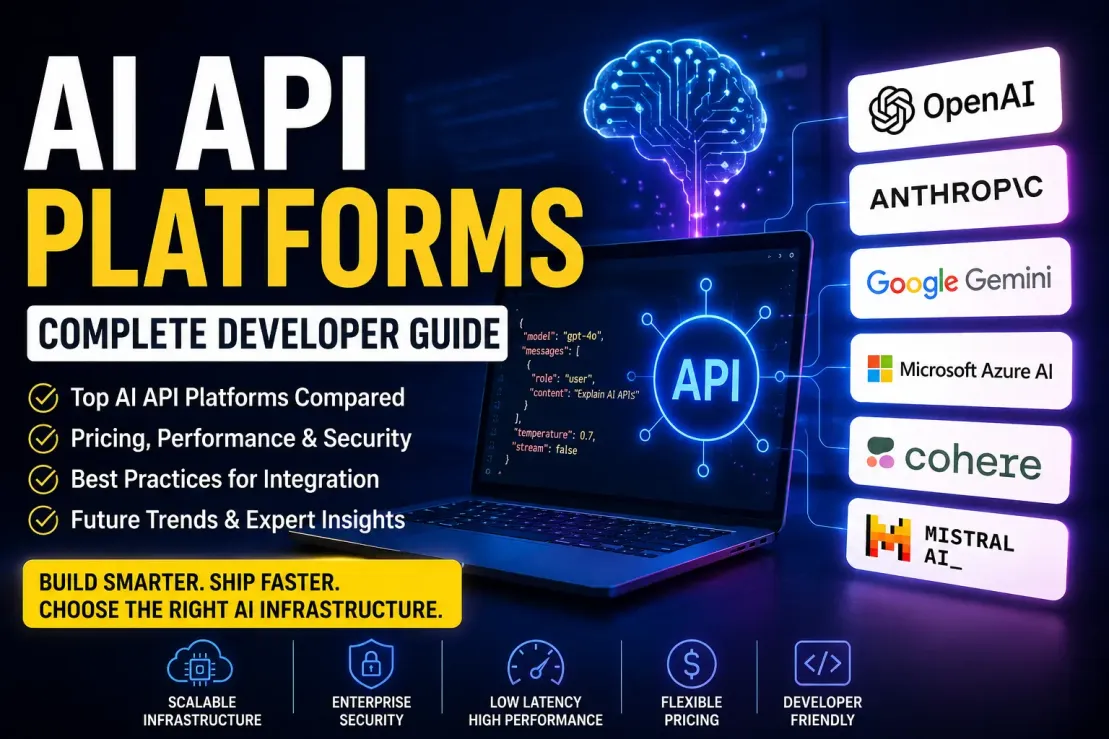
AI API Platforms Explained: How Developers Are Choosing the Infrastructure Behind the Next Generation of Intelligent Applications
Editorial
Not long ago, adding artificial intelligence to an application meant assembling machine learning pipelines, collecting massive datasets, provisioning expensive GPU infrastructure, and hiring specialized researchers. That model has changed dramatically.
Today, a single API request can summarize documents, generate production-ready code, analyze images, transcribe meetings, translate languages, create marketing copy, or power intelligent customer support. AI capabilities that once required entire research teams have become accessible through developer-friendly platforms.
Yet this new accessibility has created a different challenge.
Developers are no longer asking whether to integrate AI. They're asking which AI API platform deserves a place inside products that customers rely on every day.
That decision carries long-term consequences. The platform chosen today influences application architecture, operating costs, security posture, response quality, latency, compliance, scalability, and ultimately the user experience itself.
The market is also moving at remarkable speed. New foundation models arrive every few months, pricing structures evolve, multimodal capabilities continue expanding, and open-weight alternatives increasingly compete with proprietary systems. Choosing an AI API platform has become less about selecting a single model and more about selecting an evolving ecosystem.
This guide examines today's AI API landscape through the lens of software engineering, product strategy, and practical implementation rather than marketing claims.
Understanding AI API Platforms
At their core, AI API platforms provide developers with managed access to sophisticated artificial intelligence models through standardized interfaces.
Instead of training or hosting massive neural networks internally, developers send structured requests to cloud-hosted models and receive AI-generated responses within seconds.
The concept appears deceptively simple.
Behind each request, however, lies an enormous technology stack involving distributed GPU clusters, inference optimization, model routing, tokenization pipelines, security systems, monitoring infrastructure, and continuous model improvements that would be prohibitively expensive for most organizations to build independently.
For many engineering teams, AI APIs have become infrastructure services rather than experimental tools.
Think of them alongside cloud databases, authentication providers, payment gateways, or CDN services. They're increasingly treated as foundational building blocks within modern software architecture.
Why AI APIs Have Become the Default Choice
The shift toward API-first AI wasn't driven solely by technological progress. It reflects broader changes in software development economics.
Organizations want AI-powered products without committing millions of dollars to infrastructure, research talent, and continuous model maintenance.
Managed AI platforms dramatically reduce that barrier.
Several factors explain their widespread adoption.
Faster Product Development
Modern startups rarely have the luxury of spending months building proprietary language models.
Instead, they focus on solving customer problems.
An AI API enables teams to prototype features within days instead of quarters.
Whether building an AI coding assistant, document search engine, legal research tool, healthcare workflow, or customer support chatbot, developers can move directly into product development rather than infrastructure engineering.
Continuous Model Improvements
One overlooked advantage of managed AI platforms is that models continue improving without requiring customers to retrain or redeploy systems.
API providers frequently introduce:
- Better reasoning
- Lower latency
- Reduced hallucinations
- Expanded context windows
- Improved multilingual understanding
- Better coding performance
- Enhanced safety mechanisms
Applications often benefit from these improvements automatically, although production environments should always evaluate changes carefully before broad deployment.
Reduced Infrastructure Complexity
Training frontier AI models demands thousands of GPUs, advanced networking, extensive storage systems, and dedicated optimization teams.
Inference at global scale introduces another layer of engineering complexity.
Most organizations neither need nor want to manage this infrastructure.
AI API platforms abstract these operational challenges, allowing engineering teams to concentrate on product features instead of hardware utilization.
The AI API Ecosystem Is No Longer Dominated by a Single Company
Only a few years ago, discussions around generative AI APIs largely centered on one provider.
Today's landscape is considerably more diverse.
Competition has accelerated innovation while giving developers meaningful choices across performance, pricing, openness, and deployment flexibility.
Some providers focus on reasoning capabilities.
Get Extra 20% OFF
Launch your website today with ultra-fast, secure & premium hosting from Hostinger. Click to claim your deal!
Others prioritize enterprise compliance.
Some emphasize speed and affordability, while others invest heavily in multimodal intelligence or open-weight ecosystems.
Understanding these strategic differences is becoming increasingly important for technical decision-makers.
Major AI API Platforms Worth Evaluating
OpenAI
OpenAI remains one of the most influential companies in the AI ecosystem, offering APIs for language generation, reasoning, image understanding, speech recognition, text-to-speech, embeddings, and multimodal interactions.
Its developer ecosystem is mature, documentation is comprehensive, SDK support is extensive, and integration experiences continue improving.
Many SaaS companies choose OpenAI because of:
- Reliable infrastructure
- Strong reasoning capabilities
- Broad ecosystem adoption
- Frequent model updates
- Excellent developer documentation
OpenAI's influence also extends beyond APIs through enterprise integrations and partnerships that have helped normalize AI-powered workflows across industries.
Anthropic
Anthropic has positioned itself differently.
Rather than competing solely on benchmark performance, the company places significant emphasis on AI safety, controllability, constitutional alignment, and enterprise trust.
Its Claude family of models has gained recognition for:
- Long-context document processing
- High-quality writing
- Code generation
- Careful instruction following
- Enterprise-oriented workflows
Organizations dealing with complex documentation, legal analysis, research synthesis, or internal knowledge systems frequently evaluate Claude alongside other leading providers.
Google Gemini
Google approaches AI from the perspective of an established cloud ecosystem.
Gemini benefits from Google's extensive research investments across machine learning, search infrastructure, multimodal reasoning, and cloud services.
For organizations already using Google Cloud, Workspace, Firebase, or Vertex AI, Gemini offers increasingly attractive integration opportunities.
Its strengths continue expanding across:
- Text generation
- Image understanding
- Video reasoning
- Code assistance
- Enterprise AI services
Rather than existing as an isolated API, Gemini increasingly operates within Google's broader AI platform strategy.
Microsoft Azure AI
Many enterprises never interact directly with foundation model providers.
Instead, they consume AI services through Microsoft Azure.
Azure provides managed access to multiple AI models while adding enterprise governance, compliance, identity management, networking controls, and deployment flexibility.
This approach appeals particularly to highly regulated industries where security and operational oversight often outweigh raw benchmark performance.
Cohere
Cohere has developed a strong reputation among enterprise customers seeking practical business applications rather than consumer-facing AI experiences.
Its platform focuses on retrieval, embeddings, multilingual understanding, enterprise search, classification, and secure deployments.
Businesses building internal AI assistants or knowledge management systems frequently include Cohere in vendor evaluations.
Mistral AI
Mistral represents another important shift in the market.
Rather than competing exclusively through proprietary models, the company has become closely associated with efficient open-weight language models.
Its APIs provide access to powerful models while also supporting organizations interested in self-hosting or hybrid deployment strategies.
For engineering teams concerned about vendor lock-in, Mistral offers an appealing balance between openness and managed infrastructure.
Comparing Leading AI API Platforms
| Platform | Primary Strength | Best For | Deployment Flexibility |
|---|---|---|---|
| OpenAI | General-purpose reasoning and ecosystem maturity | SaaS products, coding assistants, productivity apps | Cloud API |
| Anthropic | Long-context reasoning and enterprise writing | Research, legal, documentation workflows | Cloud API |
| Google Gemini | Multimodal capabilities and Google Cloud integration | Enterprise applications and Google ecosystem users | Cloud API |
| Microsoft Azure AI | Enterprise governance and compliance | Large organizations and regulated industries | Cloud & enterprise infrastructure |
| Cohere | Enterprise NLP and retrieval | Knowledge management and internal AI tools | Cloud & enterprise deployments |
| Mistral AI | Open-weight models and deployment flexibility | Startups and infrastructure-conscious developers | Cloud, hybrid, self-hosted options |
Beyond Model Quality: What Experienced Engineering Teams Actually Evaluate
Public benchmarks often dominate headlines, but they rarely determine purchasing decisions.
Production environments introduce a far broader set of considerations.
Senior engineering teams increasingly evaluate AI API platforms across dimensions such as reliability, predictable latency, token pricing, observability, version stability, regional availability, security certifications, rate limits, SDK maturity, documentation quality, and long-term roadmap confidence.
A model that performs marginally better on academic benchmarks may still be the wrong choice if it introduces unpredictable costs or operational complexity.
That shift reflects a broader maturation of the AI industry. Artificial intelligence is no longer viewed as an isolated feature—it has become a core dependency within modern software architecture. As with databases or cloud infrastructure, stability and operational excellence often matter just as much as raw capability.
Get Extra 20% OFF
Launch your website today with ultra-fast, secure & premium hosting from Hostinger. Click to claim your deal!
Security, Privacy, and Compliance: The Questions That Matter Before You Ship
Adding an AI API to your application is rarely just a technical integration. For many businesses, it's also a data governance decision.
Whether you're building an HR platform, healthcare application, financial service, legal research tool, or enterprise knowledge assistant, your AI provider may process sensitive customer information. That raises legitimate questions about privacy, compliance, and long-term trust.
Before selecting an AI API platform, development teams should understand:
- Where data is processed
- Whether prompts are retained
- How long logs are stored
- Available encryption standards
- Compliance certifications (SOC 2, ISO 27001, GDPR support, HIPAA options where applicable)
- Data residency capabilities
- Model training policies
Many leading providers now offer enterprise agreements that ensure customer data isn't used to train future models. This has become a major purchasing factor, particularly among organizations operating in regulated industries.
Security isn't a feature that can be added later. Once an AI capability becomes deeply embedded in a product, migrating providers can be expensive. Evaluating governance early often saves significant engineering effort down the road.
Pricing Models Are More Complex Than They First Appear
Developers often compare AI platforms based on their published price per million tokens. While that's a useful starting point, it rarely reflects the actual cost of operating an AI-powered product.
Real-world expenses depend on several variables:
- Prompt size
- Output length
- Number of API calls
- Context window usage
- Model selection
- Image or audio processing
- Embedding generation
- Retrieval pipelines
- Caching strategies
For example, an AI customer support application might appear inexpensive during development but become significantly more costly once thousands of daily conversations generate millions of input and output tokens.
Engineering teams increasingly monitor AI costs in real time, much like cloud infrastructure spending. Token optimization, prompt engineering, and intelligent caching have become practical cost-control techniques rather than academic exercises.
The most successful SaaS companies don't simply choose the cheapest model—they select the one that provides the best balance between capability, response quality, latency, and operational cost.
Performance Is About More Than Model Intelligence
A highly capable model isn't necessarily the best experience for end users.
Imagine a coding assistant that consistently produces excellent answers but takes 15 seconds to respond. Compare that to a slightly less capable model that replies in under two seconds. In many consumer applications, perceived responsiveness has a direct impact on user satisfaction.
Developers therefore evaluate:
Response Latency
Fast responses create smoother conversational experiences, particularly in chat interfaces, productivity software, and customer support tools.
Reliability
Production systems require consistent uptime and predictable behavior. Frequent outages or unstable model updates can disrupt entire products.
Scalability
An AI feature that performs well during testing must also handle thousands—or even millions—of requests under real-world conditions.
Context Window
Modern applications increasingly process lengthy documents, contracts, source code repositories, research papers, and knowledge bases. Larger context windows reduce the need for complex document chunking while improving user experience.
The Rise of Multimodal AI APIs
The conversation around AI APIs has moved beyond text.
Modern platforms increasingly support multimodal interactions, allowing developers to combine text, images, audio, video, and structured data within a single workflow.
This shift is enabling applications that would have seemed ambitious only a few years ago.
Examples include:
- Customer support systems that analyze screenshots
- Mobile apps capable of identifying products through photos
- Educational platforms explaining diagrams
- Healthcare assistants interpreting medical imagery alongside written reports
- Real estate applications describing uploaded property images
- Meeting assistants that transcribe, summarize, and generate action items from recorded conversations
Rather than treating different media types as separate AI tasks, many platforms now expose unified APIs capable of reasoning across multiple inputs.
For product managers, this significantly expands the design possibilities for future applications.
ALSO READ: HOW TO RANK IN AI SEARCHES
Vendor Lock-In Is Becoming a Strategic Consideration
One of the most significant architectural discussions in AI development isn't about which model is best—it's about flexibility.
Organizations increasingly recognize that the AI landscape changes quickly.
A provider that leads today may face stronger competition within months.
As a result, many engineering teams build abstraction layers that allow them to switch between providers without rewriting their applications.
Popular strategies include:
- Standardized API wrappers
- Model routing systems
- Gateway services
- Open-source orchestration frameworks
- Multi-provider failover architectures
This approach offers several advantages.
If one provider experiences downtime, requests can be redirected. If pricing changes dramatically, workloads can shift elsewhere. If a new model demonstrates superior performance for a particular task, it can be introduced with minimal disruption.
Rather than committing entirely to a single ecosystem, many mature engineering organizations are designing for optionality.
Get Extra 20% OFF
Launch your website today with ultra-fast, secure & premium hosting from Hostinger. Click to claim your deal!
Best Practices for Integrating AI APIs
Successful AI products rarely rely on a single API call. Instead, they combine thoughtful engineering practices with careful product design.
Some recommendations consistently emerge across experienced development teams:
Design Prompts as Software Components
Prompts shouldn't be treated as random text written directly into application code.
Version them.
Test them.
Document them.
Review changes through the same engineering processes used for other production components.
Validate Model Outputs
Even the most advanced language models occasionally produce inaccurate or incomplete information.
Applications should validate outputs where accuracy matters.
Depending on the use case, validation may involve:
- Business rules
- Database verification
- Human review
- Secondary AI evaluation
- Confidence thresholds
AI should support decision-making—not replace necessary safeguards.
Monitor Production Behavior
Launching an AI feature isn't the end of the development process.
Teams should continuously monitor:
- Latency
- Error rates
- Token usage
- Cost per request
- User feedback
- Prompt success rates
- Hallucination frequency
- Customer satisfaction
Observability has become a core discipline within AI engineering.
Build with Future Models in Mind
Foundation models improve rapidly.
Applications designed with modular architectures can adopt new capabilities without requiring extensive rewrites.
Separating business logic from AI implementation makes long-term maintenance considerably easier.
ALSO READ: WORDPRESS VS HPANEL for website users
Common Mistakes Developers Make When Choosing AI API Platforms
The excitement surrounding generative AI sometimes leads teams to prioritize novelty over practicality.
Several recurring mistakes appear across early implementations:
- Selecting the most powerful model for every task, even when lighter models provide comparable results.
- Ignoring long-term operational costs during early development.
- Failing to evaluate security and compliance requirements.
- Hardcoding prompts without version control.
- Assuming benchmark scores directly translate into user satisfaction.
- Neglecting fallback mechanisms when APIs become unavailable.
- Overlooking rate limits and scalability constraints.
Avoiding these pitfalls often has a greater impact on project success than choosing between two similarly capable models.
Where the AI API Market Is Headed
The next phase of AI APIs is unlikely to focus solely on larger language models.
Instead, the market appears to be evolving toward more specialized capabilities.
Several trends are already shaping the industry:
- Smaller models optimized for speed and efficiency.
- Domain-specific reasoning for sectors such as healthcare, law, finance, and software engineering.
- AI agents capable of planning and executing multi-step tasks.
- Expanded multimodal interactions combining text, speech, vision, and video.
- Increased support for on-device inference.
- Greater enterprise demand for private deployments and sovereign AI infrastructure.
- Improved interoperability between AI platforms and existing cloud ecosystems.
Rather than replacing traditional software development, AI APIs are becoming another layer within modern application architecture—one that complements databases, cloud services, analytics, and automation platforms.
Pros & Cons of AI API Platforms
| Pros | Cons |
|---|---|
| Rapid AI integration without training models | Ongoing operational costs |
| Access to continuously improving models | Potential vendor lock-in |
| Scalable cloud infrastructure | Dependence on third-party availability |
| Lower engineering complexity | Data governance considerations |
| Rich ecosystem of SDKs and tools | Model behavior can change over time |
ALSO READ: Can you start business with AI tools
External Authority Mentions
Readers seeking deeper technical documentation and platform-specific guidance should explore resources published by:
- OpenAI
- Anthropic
- Google Cloud
- Microsoft Azure
- Amazon Web Services (AWS)
- Cohere
- Mistral AI
- Hugging Face
- Linux Foundation AI initiatives
- OWASP guidance for AI security
These organizations continue to shape standards, tooling, and best practices across the AI development ecosystem.
Final Thoughts
The conversation around AI API platforms has matured considerably. The question is no longer whether artificial intelligence belongs in modern software—it already does. The real challenge is choosing infrastructure that aligns with your product goals, engineering practices, and long-term business strategy.
The strongest teams increasingly evaluate AI platforms with the same rigor they apply to databases, cloud providers, or payment systems. They look beyond benchmark charts and consider operational resilience, governance, developer experience, cost efficiency, and architectural flexibility.
As foundation models continue to evolve, adaptability may become the most valuable capability of all. Products built with modular AI architectures, clear observability, and thoughtful provider selection will be better positioned to benefit from future advances without constant reinvention.
For developers, startup founders, and technical decision-makers, selecting an AI API platform is no longer just a feature choice. It's an infrastructure decision that shapes how software will be built, maintained, and experienced in the years ahead.







💬 Comments (0)
🔒 Please login to post a comment.
Login Now