
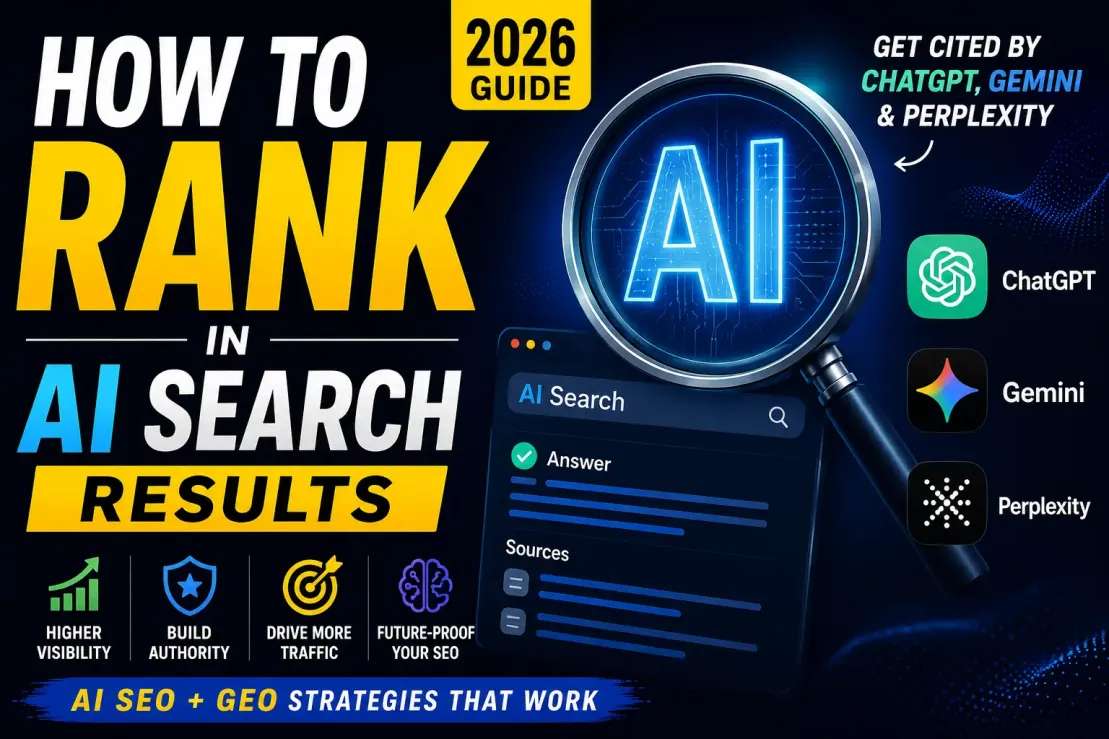
How to Rank in AI Search Results: A Technical Guide to ChatGPT, Gemini & Perplexity
For nearly three decades, winning organic traffic meant understanding how search engines ranked web pages. Publishers optimized titles, built backlinks, improved page speed, and targeted keywords in hopes of reaching Google's first page.
That model is changing.
Today, millions of people begin their research inside AI assistants instead of traditional search engines. They ask ChatGPT for buying advice, compare products using Perplexity, or rely on Gemini for research, coding help, travel planning, and business decisions. Rather than returning ten blue links, these systems generate direct answers—often citing only a handful of trusted sources.
That shift has created a new challenge for publishers, marketers, and business owners.
The question is no longer just "How do I rank on Google?"
It's increasingly becoming:
"How do I become one of the sources AI chooses to trust?"
The answer isn't about abandoning SEO. It's about expanding it.
Modern visibility depends on a combination of traditional search optimization, semantic understanding, topical authority, structured information, brand trust, and genuine expertise. In industry circles, this evolution is often described as Generative Engine Optimization (GEO)—optimizing content so large language models can confidently discover, understand, and reference it.
This guide explains exactly how AI search works, why traditional SEO alone is no longer enough, and the foundational principles that increase your chances of being cited by platforms like ChatGPT, Gemini, and Perplexity.
What Is AI Search?
AI search replaces the familiar list of search results with a synthesized answer generated by a large language model (LLM). Instead of asking users to visit multiple websites and piece together information themselves, the AI reads, compares, evaluates, and summarizes information from trusted sources before responding.
Depending on the platform and the query, these systems may:
- Summarize information from multiple websites
- Cite authoritative sources
- Compare products
- Explain complex concepts
- Recommend tools
- Answer follow-up questions
- Generate personalized responses based on context
The experience feels less like using a search engine and more like consulting a knowledgeable research assistant.
For users, that's convenient.
For publishers, it fundamentally changes how content earns visibility.
Traditional Search vs AI Search
| Feature | Traditional Search | AI Search |
|---|---|---|
| Primary output | List of webpages | Direct generated answer |
| User journey | Click multiple results | Receive summarized response |
| Ranking goal | Position on SERP | Become a cited source |
| Optimization focus | Keywords & backlinks | Authority, entities, context, trust |
| User interaction | Single query | Multi-turn conversations |
| Information retrieval | Index-based | Retrieval + language models |
A page that ranks #3 in Google may never appear inside an AI-generated response if it lacks authority, clear factual structure, or topical relevance. Conversely, a highly trusted niche publication can be cited frequently despite having modest organic rankings.
Platform-Specific Ranking Strategies
Not all AI search engines are built the same. They rely on different underlying models, different web crawlers, and different user intents. Here is a breakdown of the big three.
1. Optimizing for Perplexity (The Citation Engine)
Perplexity is arguably the most aggressive and successful pure AI search engine on the market. It functions primarily as an answer engine that wears its citations on its sleeve.
To rank in Perplexity:
-
Prioritize Factual Density: Perplexity ignores lengthy narrative introductions. It looks for raw data. If you are writing a guide on software testing, lead with statistics, hard definitions, and step-by-step lists.
-
Publish Original Research: Perplexity’s RAG system heavily favors sources that provide net-new information. If your article is just a rewritten version of the top five Google results, Perplexity has no reason to cite you. You need original quotes, proprietary data, or unique case studies.
-
Update Frequently: Freshness is a massive ranking factor for Perplexity. Make sure your articles are updated regularly with current-year data, and ensure your XML sitemaps ping crawlers quickly.
2. Getting Featured in ChatGPT Search
OpenAI’s search functionality (often integrated with Bing’s index) favors conversational context. Users ask ChatGPT follow-up questions, meaning your content needs to cover topics comprehensively to remain relevant throughout a multi-turn conversation.
To rank in ChatGPT:
Get Extra 20% OFF
Launch your website today with ultra-fast, secure & premium hosting from Hostinger. Click to claim your deal!
-
Optimize for Bing Webmaster Tools: ChatGPT relies heavily on Bing’s search infrastructure for live web retrieval. If your site isn’t indexed and ranking well in Bing, you simply won't appear in ChatGPT’s real-time answers.
-
Use Natural Language Q&A Formats: Structure your H2s and H3s as the exact conversational questions a user might ask an AI. Answer the question immediately below the header in 40-60 words.
-
Build Entity Authority: ChatGPT connects concepts. If you want to rank for "best email marketing software," your content needs to naturally mention related entities: automation workflows, deliverability rates, specific competitors (Mailchimp, ConvertKit), and protocols like DMARC.
3. Ranking in Google Gemini (and AI Overviews)
Google’s approach with Gemini and AI Overviews is heavily tied to its existing Knowledge Graph and EEAT (Experience, Expertise, Authoritativeness, Trustworthiness) guidelines.
To rank in Google's AI surfaces:
-
Lean into First-Hand Experience: Google actively attempts to filter out generic AI-generated content. To be cited by Gemini, your content must feature human elements—"I tested this," "In our agency's experience," or original photography.
-
Implement Flawless Schema Markup: AI Overviews pull heavily from structured data. Ensure your Article, FAQ, Product, and HowTo schema are perfectly executed. This removes the guesswork for Google's parsers.
-
Target Long-Tail and Complex Queries: AI Overviews trigger most often for complex, multi-layered questions where a standard link isn't enough. Build content that answers composite questions (e.g., "What is the difference between Roth IRA and Traditional IRA for a 35-year-old freelancer?").
How ChatGPT, Gemini and Perplexity Find Information
Although these AI platforms often appear similar, they don't all retrieve information in the same way.
Understanding those differences helps explain why some websites are cited repeatedly while others rarely appear.
ChatGPT
ChatGPT combines advanced language models with web retrieval for many queries, allowing it to incorporate current information when appropriate. Rather than ranking pages in the traditional sense, it looks for reliable, well-structured, and relevant information that can support an accurate answer.
Content that is clear, authoritative, and backed by strong signals of expertise has a better chance of being referenced.
One important point: ChatGPT isn't simply copying Google's rankings. It evaluates information through its own retrieval and reasoning process, which means visibility depends on more than just traditional SEO performance.
Gemini
Gemini benefits from Google's broader search ecosystem, including its understanding of web content, entities, and knowledge graphs.
Because of that relationship, many established SEO best practices remain valuable:
- Strong EEAT signals
- Comprehensive topical coverage
- Clear semantic structure
- Accurate factual information
- High-quality user experience
Publishers with consistent topical authority often perform well because Google's broader understanding of expertise can influence how information is surfaced.
Perplexity
Perplexity places unusual emphasis on citations.
Unlike many conversational AI tools, it openly references the sources used to construct its answers. That makes it easier to observe which kinds of content earn visibility.
Across many industries, cited pages tend to share several characteristics:
- Original reporting
- Detailed explanations
- Well-organized headings
- Recent information
- Credible references
- Clear factual statements
Rather than rewarding sensational headlines, Perplexity often favors pages that read like trustworthy reference material.
ALSO READ: WHY FRESH CONTENT GOOGLE LOVES , AND GIVES MORE TRAFFIC
5 Core Tactics to Future-Proof Your Content for AI
Optimizing for LLMs requires a shift from writing for clicks to writing for extraction. Here are five practical strategies to implement.
1. Adopt the BLUF Method (Bottom Line Up Front)
LLMs have a limited context window when they scrape a page for RAG. If your actual answer is buried beneath a 500-word story about how much you love marketing, the AI will likely skip your page for a more direct source. State the exact answer, definition, or conclusion in the first two paragraphs. Provide the nuance and explanation afterward.
2. Maximize Information Gain
Information Gain is a patented Google concept, but the principle applies to all AI search engines. It measures how much new information a document brings to a cluster of existing documents. If an LLM already has the basic facts about a topic in its training data, it searches the live web for what it doesn't know. Provide expert quotes, unique frameworks, and contrarian (but proven) viewpoints.
3. Structure with Markdown-Friendly Formatting
AI models process text similarly to how developers read Markdown. They love structure.
Get Extra 20% OFF
Launch your website today with ultra-fast, secure & premium hosting from Hostinger. Click to claim your deal!
-
Use strict, logical heading hierarchies (H1 > H2 > H3).
-
Use bulleted and numbered lists for steps or features.
-
Bold key concepts and entities.
-
Use tables for comparative data. A clean HTML table is incredibly easy for an LLM to parse and extract into its own generated response.
4. Optimize Your Brand as an Entity
AI search engines don’t just read your website; they read about your website. Mentioning trusted organizations naturally signals authority. Ensure your brand or name is consistently connected to your core topics across digital PR, podcast transcripts, YouTube descriptions, and Wikipedia or Wikidata entries. When Perplexity builds context on a topic, you want your brand to be recognized as a semantic node connected to that subject.
5. Write Highly Quotable Snippets
Provide tight, 30-to-40 word summaries at the end of complex sections. Think of these as "AI soundbites." If you make it mathematically easy for the model’s algorithmic weights to select your sentence as the best possible summary of a concept, your citation rate will skyrocket.
What AI Systems Look for Before Referencing Your Content
Although every platform uses different retrieval methods, several consistent patterns have emerged across AI-generated search experiences.
High-performing sources typically demonstrate the following qualities:
Clear topical expertise
AI models prefer websites that consistently publish around a focused subject instead of covering unrelated topics sporadically.
A cybersecurity publication is generally more credible on ransomware than a general lifestyle blog with a single article on the topic.
ALSO READ: HOW TO BUY HOSTING FROM HOSTINGER WITH DISCOUNT 20%
Comprehensive coverage
Pages that answer multiple related questions often outperform thin articles optimized for a single keyword.
Rather than offering a quick definition, strong content explains:
- what something is,
- why it matters,
- how it works,
- practical examples,
- limitations,
- best practices,
- comparisons,
- and common misconceptions.
That depth helps AI systems extract accurate, well-rounded answers.
Strong factual structure
Large language models process information more effectively when it is organized logically.
Content with descriptive headings, concise explanations, comparison tables, definitions, and structured sections is easier for AI systems to interpret than long, unbroken blocks of text.
Evidence and credibility
Original research, expert commentary, industry reports, public documentation, and transparent sourcing all strengthen trust signals.
While opinion has its place, unsupported claims are less likely to become reliable references.
Freshness
Technology evolves rapidly.
Articles that are reviewed and updated regularly tend to remain more useful than content that reflects outdated products, policies, or industry practices.
Readers—and increasingly AI systems—expect current information.
ALSO READ: SEO VS GEO, WHICH GIVE MORE TRAFFIC
Write for Questions, Not Just Keywords
Traditional keyword research still matters, but AI assistants process language conversationally.
People no longer search only:
- AI SEO
They ask:
Get Extra 20% OFF
Launch your website today with ultra-fast, secure & premium hosting from Hostinger. Click to claim your deal!
- How do I get ChatGPT to recommend my website?
- Why isn't my content appearing in AI search?
- Does structured data help AI?
- Can AI summarize my blog?
- How do large language models choose sources?
Each question represents real user intent.
Content that answers these naturally is easier for AI systems to retrieve during conversations.
Instead of writing:
"Semantic SEO is important."
Write:
What is Semantic SEO?
Semantic SEO helps search engines and AI systems understand the meaning behind your content instead of relying only on exact keyword matches. By covering related entities, concepts, and user questions, semantic optimization improves the chances that your content can be retrieved for a wider variety of conversational searches.
Notice how the second version is self-contained.
That's exactly the type of paragraph AI systems can easily quote.
Create Content That Can Be Quoted
This is one of the most overlooked aspects of AI optimization.
Large language models don't simply index pages.
They retrieve information.
That means your article should contain numerous sections that can stand on their own.
For example:
Weak paragraph
"Our software has lots of useful features that improve productivity for businesses."
This says very little.
Strong paragraph
Project management software improves team productivity by centralizing task tracking, communication, deadlines, file sharing, and reporting in a single workspace. This reduces context switching and makes collaboration easier across remote teams.
The second paragraph answers a complete question.
It's factual.
It's concise.
It doesn't rely on surrounding context.
That's exactly the kind of content AI systems prefer to retrieve.
What to Avoid: Tactics That LLMs Ignore
Just as important as what to do is knowing what to stop doing. Certain legacy SEO tactics actively harm your chances of ranking in AI search.
-
Fluff and Keyword Stuffing: LLMs easily detect semantic bloat. Repeating a keyword doesn't make a document more relevant to an AI; it just dilutes the factual density.
-
Aggressive Affiliate Layouts: Pages overloaded with display ads, pop-ups, and complex JavaScript rendering can time-out crawler requests. Keep your DOM structure clean.
-
Ambiguous Language: Avoid phrases like "it depends" unless you immediately outline exactly what it depends on. AI models prefer definitive, well-supported claims.
-
Final Thoughts on the AI Search Transition
The transition to AI search isn't a future possibility; it is the current reality of the web. The publications and brands that survive this shift won't be the ones trying to trick LLMs with invisible text or mass-produced AI content.
The winners will be the subject matter experts who provide deep, uniquely human insights, backed by original data, and formatted cleanly for machine extraction. Stop writing for the algorithm you had five years ago. Start writing to be the most definitive, easily digestible source of truth on the internet.



💬 Comments (0)
🔒 Please login to post a comment.
Login Now