
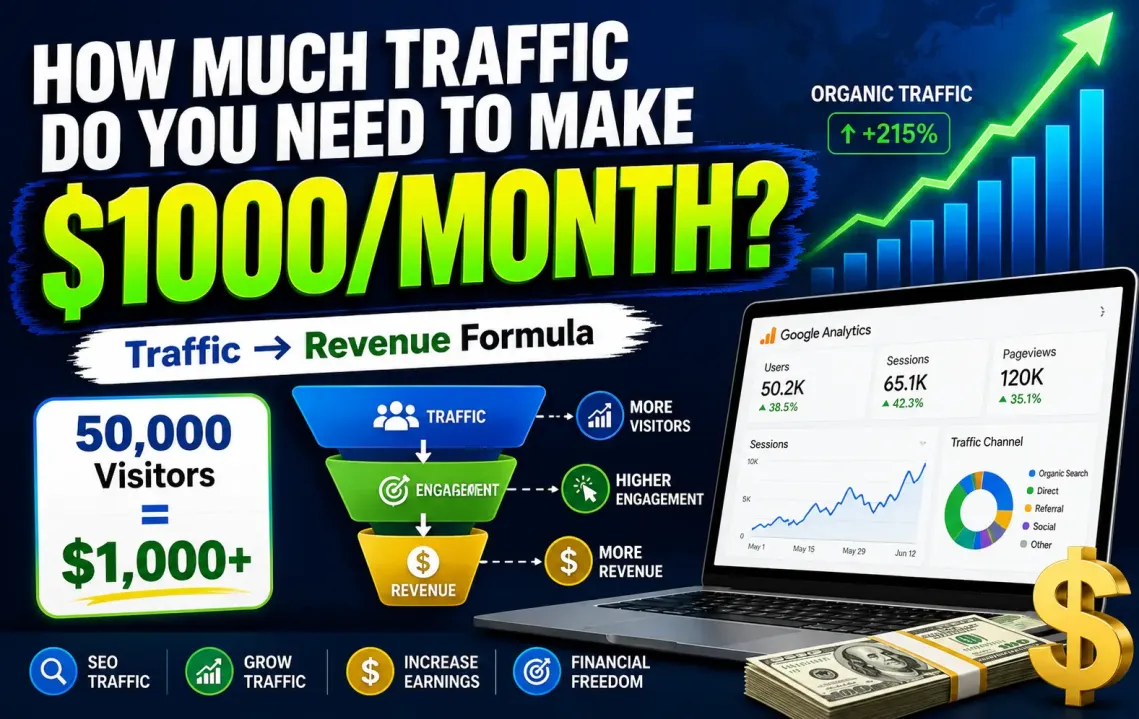
How Much Traffic Do You Need to Make $1,000 a Month? The Real Numbers Most Blogging Advice Leaves Out
Top Hook detailed for website owners
One of the most common questions in the online publishing world sounds deceptively simple:
"How much traffic do I need to make $1,000 per month?"
The answers floating around social media are often wildly inconsistent. One creator claims they reached four figures with only a few thousand monthly visitors. Another insists you need hundreds of thousands.
Both can be right.
That's because traffic, by itself, is rarely the determining factor.
The real story sits beneath the pageview count—in audience intent, monetization models, niche economics, advertiser demand, and how effectively a website converts attention into revenue.
For beginner bloggers and niche website owners, this distinction matters. Chasing traffic without understanding revenue mechanics often leads to months of publishing with disappointing results. Meanwhile, smaller websites in the right niches quietly generate meaningful income from audiences that are comparatively tiny.
So how much traffic do you actually need to earn $1,000 per month?
Let's unpack the numbers the way a digital publishing analyst would.
Understanding the Metric That Actually Matters
Most people focus on visitors.
Publishers focus on RPM.
RPM stands for Revenue Per Mille, or revenue earned per 1,000 pageviews.
It's the metric that determines whether 20,000 visitors can generate a meaningful income—or whether 200,000 still isn't enough.
The basic formula is straightforward:
Monthly Revenue = (Pageviews ÷ 1,000) × RPM
The challenge is that RPM varies dramatically.
A website about celebrity gossip and a website about business software may attract similar traffic levels while generating vastly different revenue.
Why Some Traffic Is Worth More Than Other Traffic
Not all website visitors carry the same commercial value.
Consider these search queries:
- "Funny cat videos"
- "Best CRM software for small business"
- "Personal loan rates"
- "WordPress hosting comparison"
The first query signals entertainment.
The others signal purchasing intent.
Advertisers pay substantially more to reach audiences that are closer to spending money.
This is why finance, software, insurance, legal services, and B2B technology websites often earn significantly higher advertising rates than entertainment-focused websites.
Traffic volume tells only part of the story.
Audience intent tells the rest.
Get Extra 20% OFF
Launch your website today with ultra-fast, secure & premium hosting from Hostinger. Click to claim your deal!
The Traffic Needed for $1,000/Month by Monetization Method
The answer changes depending on how you monetize.
Scenario 1: AdSense and Display Advertising
For most beginner publishers, advertising is the first monetization method.
Typical display advertising RPMs often fall into these ranges:
| Niche Type | Estimated RPM |
|---|---|
| Entertainment | $2–$8 |
| General Lifestyle | $5–$15 |
| Technology | $10–$30 |
| Finance | $20–$80+ |
| B2B Software | $30–$100+ |
Let's translate that into traffic requirements.
| RPM | Pageviews Needed for $1,000 |
|---|---|
| $5 | 200,000 |
| $10 | 100,000 |
| $20 | 50,000 |
| $30 | 33,333 |
| $50 | 20,000 |
A lifestyle blog earning a $5 RPM may require roughly 200,000 monthly pageviews.
A high-intent software website earning a $50 RPM might achieve the same income with only 20,000 pageviews.
That's a tenfold difference.
Scenario 2: Affiliate Marketing
Affiliate marketing changes the economics entirely.
Instead of earning fractions of a dollar per visitor, publishers earn commissions when users take action.
This can dramatically reduce traffic requirements.
Imagine:
- 20,000 monthly visitors
- 3% click affiliate links
- 5% conversion rate
- $50 average commission
The math becomes:
- 600 affiliate clicks
- 30 sales
- $1,500 revenue
In this scenario, 20,000 visitors outperform what might require over 100,000 pageviews through display ads alone.
This explains why many niche website operators prioritize affiliate content over purely informational content.
The visitor is no longer just generating an ad impression.
They're generating transaction opportunities.
Scenario 3: Digital Products
The traffic requirement can shrink even further.
Creators selling:
- E-books
- Templates
- Courses
- Notion systems
- Premium newsletters
- Digital downloads
often operate under entirely different economics.
A creator selling a $49 digital product only needs around 21 sales per month to reach $1,000.
If a website converts 1% of visitors into customers:
- 2,100 visitors = roughly 21 sales
- Revenue ≈ $1,029
Traffic suddenly becomes a secondary variable.
Offer quality becomes the primary one.
Get Extra 20% OFF
Launch your website today with ultra-fast, secure & premium hosting from Hostinger. Click to claim your deal!
The Traffic Myth That Traps New Bloggers
A persistent myth in blogging communities suggests that traffic automatically translates into income.
Reality is messier.
Many websites cross 100,000 monthly pageviews while struggling to generate meaningful revenue.
Others generate several thousand dollars monthly with a fraction of that audience.
The difference often comes down to three factors:
Search Intent
Visitors searching:
- Best VPN software
- Mortgage calculators
- Project management tools
are often more valuable than visitors searching purely informational topics.
Commercial intent generally creates stronger monetization opportunities.
Geography
Traffic from different countries carries different advertising value.
Publishers frequently see higher RPMs from:
- United States
- Canada
- United Kingdom
- Australia
compared with many emerging markets.
A website with 30,000 monthly visitors from the United States may earn more than a website with 150,000 visitors from lower-advertising-value regions.
This isn't about audience quality.
It's about advertiser competition.
Content Type
Some content naturally monetizes better.
High Monetization Content
- Product reviews
- Buying guides
- Software comparisons
- Financial education
- Business solutions
- Commercial tutorials
Lower Monetization Content
- General news
- Memes
- Entertainment recaps
- Viral trends
- Broad informational content
The difference can be substantial.
A Realistic Traffic Roadmap to $1,000/Month
For most independent publishers, a practical target often looks like this:
| Website Model | Monthly Traffic Goal |
|---|---|
| AdSense-focused general blog | 75,000–200,000 pageviews |
| Technology niche site | 30,000–80,000 pageviews |
| Affiliate niche website | 10,000–50,000 visitors |
| Digital product creator | 2,000–20,000 visitors |
| Mixed monetization strategy | 20,000–60,000 visitors |
Notice the pattern.
As monetization sophistication increases, required traffic often decreases.
That's one reason experienced publishers rarely focus exclusively on pageviews.
They focus on revenue efficiency.
Why RPM Has Become More Important in 2026
The economics of online publishing have shifted.
Artificial intelligence, zero-click search behavior, changing search engine result pages, and increased competition have altered traffic acquisition strategies.
Get Extra 20% OFF
Launch your website today with ultra-fast, secure & premium hosting from Hostinger. Click to claim your deal!
Publishers are discovering that:
- More traffic isn't always attainable.
- More efficient monetization often is.
Many successful niche publishers now prioritize:
- High-intent keywords
- Email list growth
- Affiliate partnerships
- First-party audience relationships
- Premium content ecosystems
rather than chasing raw traffic volume.
The modern publishing landscape rewards quality traffic more than vanity metrics.
Pros and Cons of Different Paths to $1,000/Month
| Method | Pros | Cons |
|---|---|---|
| AdSense | Passive, easy setup | Requires substantial traffic |
| Affiliate Marketing | Higher earnings potential | Conversion dependent |
| Digital Products | Highest profit margins | Requires product creation |
| Sponsored Content | Strong revenue opportunities | Requires audience authority |
| Memberships | Recurring income | Harder audience acquisition |
For many publishers, the strongest approach combines several revenue streams.
A website earning:
- $400 from ads
- $350 from affiliate commissions
- $300 from digital products
can reach $1,000 faster than relying on a single monetization channel.
The Hidden Variable: Time
Traffic discussions often overlook the most important constraint.
Time.
Building 50,000 monthly organic visitors generally takes longer than most beginners expect.
In competitive niches, reaching meaningful traffic levels may require:
- Dozens of articles
- Consistent publishing
- Link acquisition
- Technical SEO improvements
- User experience optimization
The process frequently takes months and sometimes years.
This isn't discouraging.
It's simply the economic reality of modern search-driven publishing.
The websites generating consistent revenue today are often benefiting from work done long before that revenue appeared.
Internal Linking Suggestions
Trusted Industry References
Many publishers benchmark performance using insights and tools from:
These platforms provide useful context for traffic trends, search visibility, and website monetization strategies.
Final Closing for website owners
The question "How much traffic do you need to make $1,000 per month?" sounds like a traffic question, but it's really a monetization question.
A website earning $5 RPM and a website earning $50 RPM operate in entirely different economic realities. One may need hundreds of thousands of pageviews. The other may reach the same goal with a comparatively modest audience.
For modern publishers, the more useful question is not:
"How can I get more traffic?"
It's:
"How can I make each visitor more valuable?"
That shift—from volume to efficiency—is where many profitable websites separate themselves from the vast majority that remain trapped in the traffic chase.





💬 Comments (0)
🔒 Please login to post a comment.
Login Now