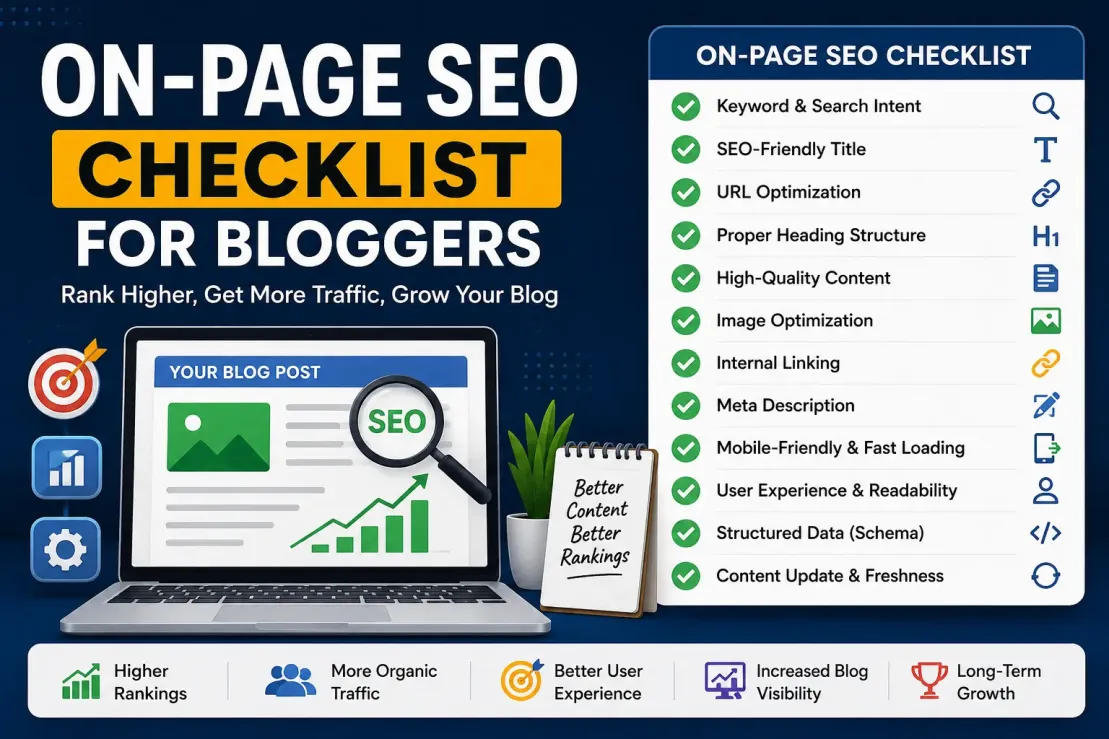
On-Page SEO Checklist for Bloggers That Actually Reflects How Google Understands Content in 2026
The biggest SEO mistake isn't writing bad content—it's publishing content Google struggles to understand.
Ask ten beginner bloggers why their articles never rank, and you'll hear familiar answers.
"The competition is too high."
"Google only ranks big websites."
"Maybe I need more backlinks."
Those explanations are sometimes true—but surprisingly often, they aren't the real problem.
Many blogs fail long before backlinks become relevant. The content itself sends mixed signals. Headlines don't match search intent. Images lack context. Internal links are missing. Pages compete with one another. Metadata promises one thing while the article delivers another.
Google has become remarkably good at evaluating quality, but it still depends on clear signals to understand what a page is about, who it helps, and whether it deserves visibility.
That's exactly where on-page SEO matters.
It's no longer about inserting a keyword ten times. Modern on-page SEO is about creating pages that are technically understandable, contextually rich, easy to navigate, and genuinely useful for readers.
If you're publishing on WordPress, Blogger, or any modern CMS—or even writing AI-assisted content—this checklist reflects what actually matters in 2026.
What Is On-Page SEO?
On-page SEO refers to every optimization made within an individual webpage to help search engines understand its purpose while improving the reader's experience.
Unlike off-page SEO, which focuses on backlinks and authority, on-page optimization is completely under your control.
It includes:
- Page titles
- Headings
- URL structure
- Content quality
- Search intent alignment
- Images
- Internal linking
- Metadata
- User experience
- Content freshness
- Semantic relevance
Think of it this way: backlinks may introduce Google to your page, but on-page SEO explains why it deserves to rank.
Why On-Page SEO Has Changed in 2026
Search engines no longer rely primarily on exact keywords.
Large language models, semantic indexing, entity recognition, and Google's evolving ranking systems have fundamentally changed how pages are evaluated.
Instead of asking:
"Did this article include the keyword?"
Google increasingly asks:
- Does this page answer the searcher's real question?
- Is the information trustworthy?
- Does the content demonstrate expertise?
- Is it well organized?
- Does it connect naturally with related concepts?
- Would readers likely stay and continue exploring?
That's a meaningful shift.
Modern SEO is less about optimization tricks and more about reducing ambiguity.
ALSO READ: HOW TO GET REPEAT VISITORS IN YOUR BLOG
The Complete On-Page SEO Checklist for Bloggers
1. Start With Search Intent—Not Keywords
Every successful article begins with understanding why someone searched.
A keyword can have multiple meanings.
For example:
Get Extra 20% OFF
Launch your website today with ultra-fast, secure & premium hosting from Hostinger. Click to claim your deal!
"WordPress SEO"
Some readers want plugins.
Others need beginner tutorials.
Some are comparing WordPress with Blogger.
Trying to satisfy every possible audience usually satisfies none.
Instead:
- Identify the dominant search intent.
- Match your introduction to that intent.
- Avoid unnecessary detours.
Google rewards pages that answer the question users actually asked.
2. Write Headlines That Set Accurate Expectations
Your title influences both rankings and click-through rate.
Good titles are:
- Clear
- Specific
- Honest
- Benefit-focused
Instead of:
SEO Tips
Try:
On-Page SEO Checklist for Bloggers: 25 Practical Steps That Improve Rankings
Avoid sensational promises.
Readers—and search engines—notice when headlines overpromise.
3. Keep URLs Clean
Simple URLs remain easier for users and search engines.
Good:
yourdomain.com/on-page-seo-checklist-bloggersAvoid:
yourdomain.com/post?id=5467&category=seo&year=2026Short URLs communicate relevance more clearly.
4. Optimize Your Heading Structure
Every article should have:
- One H1
- Logical H2 sections
- Supporting H3 headings where necessary
Avoid jumping randomly between heading levels.
A clean hierarchy helps readers skim content while helping search engines understand topical relationships.
5. Answer the Main Question Early
Many blogs delay the answer.
Readers don't.
Within the first few paragraphs, explain exactly what the article covers.
Get Extra 20% OFF
Launch your website today with ultra-fast, secure & premium hosting from Hostinger. Click to claim your deal!
This improves user satisfaction and increases the chances of appearing in featured snippets.
6. Write for Topics, Not Keyword Density
Keyword stuffing disappeared from effective SEO years ago.
Instead, naturally discuss related concepts.
A page about on-page SEO should naturally mention:
- Meta descriptions
- Internal links
- Canonical URLs
- Search intent
- Structured data
- Image optimization
- Content hierarchy
- User experience
This creates semantic depth without sounding repetitive.
7. Create Helpful, Comprehensive Content
Length alone doesn't improve rankings.
Coverage does.
Readers appreciate content that answers follow-up questions before they need to search again.
That's one reason comprehensive guides consistently outperform shallow listicles.
8. Optimize Images Properly
Images contribute more than visual appeal.
Every image should include:
- Descriptive filename
- Relevant alt text
- Compressed file size
- Appropriate dimensions
Large uncompressed images often become one of the biggest performance bottlenecks.
9. Strengthen Internal Linking
Internal links help readers discover related content while helping search engines understand your site's topical structure.
Instead of adding random links, connect pages that naturally extend the conversation.
Examples:
- SEO Writing Tips
- Technical SEO Basics
- Keyword Research Guide
- Google Search Console Tutorial
A thoughtful internal linking strategy gradually builds topical authority.
10. Optimize Meta Titles and Descriptions
These aren't direct ranking factors in the traditional sense, but they significantly influence clicks.
Good metadata should:
- Reflect page content
- Include the primary topic naturally
- Encourage curiosity without exaggeration
Remember that your search snippet often forms a reader's first impression.
11. Improve Readability
SEO isn't only about search engines.
If readers struggle to consume your content, rankings often follow.
Simple improvements include:
- Short paragraphs
- Meaningful subheadings
- Bullet points
- Tables
- Natural transitions
- White space
Readable pages generally keep visitors engaged longer.
12. Add Context Through Entities
Rather than repeatedly mentioning "SEO," reference related technologies naturally.
Examples include:
Get Extra 20% OFF
Launch your website today with ultra-fast, secure & premium hosting from Hostinger. Click to claim your deal!
- Google Search
- Google Search Console
- Google Analytics
- Schema.org
- Core Web Vitals
- HTML
- WordPress
- Blogger
- Bing Webmaster Tools
These entities help reinforce topical relevance without forcing keywords.
13. Keep Content Updated
One overlooked ranking factor is freshness.
Articles published three years ago aren't necessarily outdated.
Articles that still recommend discontinued plugins or obsolete practices are.
Regular updates demonstrate ongoing maintenance.
14. Improve Page Experience
Content quality and user experience increasingly work together.
Focus on:
- Fast loading speed
- Mobile responsiveness
- Stable layouts
- Readable typography
- Minimal intrusive popups
Better experiences often produce stronger engagement signals.
15. Add Structured Data Where Appropriate
Structured data doesn't guarantee rankings.
It improves understanding.
Common schema includes:
- FAQ
- Article
- Breadcrumb
- Organization
- Author
Rich results often improve search visibility.
ALSO READ: HOW FRESH CONTENT HELPS SEO
Practical On-Page SEO Checklist
| Task | Priority | Status |
|---|---|---|
| Understand Search Intent | High | ☐ |
| Write an SEO-Optimized Title | High | ☐ |
| Create a Clean, Keyword-Friendly URL | High | ☐ |
| Use Only One H1 Heading | High | ☐ |
| Organize Content with H2 & H3 Headings | High | ☐ |
| Optimize Images (Alt Text & Compression) | Medium | ☐ |
| Add Relevant Internal Links | High | ☐ |
| Write a Compelling Meta Description | Medium | ☐ |
| Compress Images & Page Assets | Medium | ☐ |
| Update Outdated Content Regularly | High | ☐ |
| Include the Focus Keyword Naturally | High | ☐ |
| Improve Page Loading Speed | High | ☐ |
| Ensure Mobile-Friendly Design | High | ☐ |
| Add External Links to Trusted Sources | Medium | ☐ |
| Use Short, Readable Paragraphs | Medium | ☐ |
| Implement FAQ Schema (JSON-LD) | Medium | ☐ |
| Add Descriptive Image File Names | Medium | ☐ |
| Check Grammar and Readability | Medium | ☐ |
| Preview the Post Before Publishing | Low | ☐ |
| Submit the URL to Google Search Console | High | ☐ |
AI Can Help—But It Can't Replace Editorial Judgment
AI writing assistants have become part of many publishing workflows.
Whether you're using ChatGPT, Gemini, Claude, or another model, the challenge isn't generating text. It's producing content that demonstrates originality, relevance, and editorial judgment.
A useful workflow in 2026 looks something like this:
- Research multiple reputable sources before drafting.
- Use AI to brainstorm outlines or improve clarity—not to invent facts.
- Add first-hand observations, examples, or testing where possible.
- Review every claim for accuracy.
- Edit for tone, structure, and redundancy.
Search engines aren't evaluating whether AI was involved. They're evaluating whether the final page is genuinely helpful.
That distinction matters.
Common On-Page SEO Mistakes Bloggers Still Make
Even experienced publishers occasionally overlook fundamentals.
Some of the most common issues include:
- Publishing multiple articles targeting the same keyword (keyword cannibalization).
- Ignoring internal links after hitting "Publish."
- Reusing identical title tags across pages.
- Writing introductions that bury the answer.
- Uploading oversized images that slow page speed.
- Neglecting content updates after major Google changes.
- Using AI-generated text without meaningful editing or fact-checking.
These problems are usually fixable—and addressing them can have a noticeable impact over time.
Pros and Cons of a Strong On-Page SEO Strategy
Pros
- Better indexing and crawlability.
- Higher relevance for target search queries.
- Improved user experience.
- Increased organic traffic over time.
- Better foundation for earning backlinks.
- Higher click-through rates with optimized metadata.
- Supports long-term topical authority.
Cons
- Results typically take time rather than appearing overnight.
- Requires regular updates as search behavior evolves.
- Competitive niches still need authority signals beyond on-page optimization.
- Technical improvements may require additional learning for beginners.
ALSO READ: AI VS MACHINE LEARNING VS DEEP LEARNING
Trusted Organizations and Platforms Worth Following
If you're serious about improving your on-page SEO skills, it's worth keeping an eye on guidance and updates from organizations and platforms that shape the search ecosystem. Google's Search Central documentation remains the primary reference for webmaster recommendations, while Google Search Console provides invaluable insights into indexing, crawl issues, and search performance. Analytics platforms help you understand user behavior beyond rankings, and structured data standards from Schema.org continue to influence how search engines interpret page content. Content management systems like WordPress have also evolved to make many technical optimizations more accessible through modern themes and plugins, but they still require informed editorial decisions to be effective.
Final Thoughts: Think Like an Editor, Not Just an Optimizer
The most successful blogs in search results rarely win because they've mastered a checklist alone. They succeed because every optimization serves a larger editorial purpose: making information easier to discover, understand, trust, and revisit.
An on-page SEO checklist is useful, but it isn't a substitute for thoughtful publishing. The strongest pages begin with a clear understanding of the reader's intent, build credibility through accurate and well-structured information, and remain valuable long after they're first published. Technical refinements—from clean headings to internal links and metadata—support that goal rather than define it.
For bloggers, affiliate marketers, freelancers, and digital publishers, the opportunity in 2026 isn't to outsmart search algorithms. It's to create content that aligns with how modern search engines evaluate quality and how real people consume information. When those two priorities converge, rankings tend to become a by-product rather than the sole objective.





💬 Comments (0)
🔒 Please login to post a comment.
Login Now