
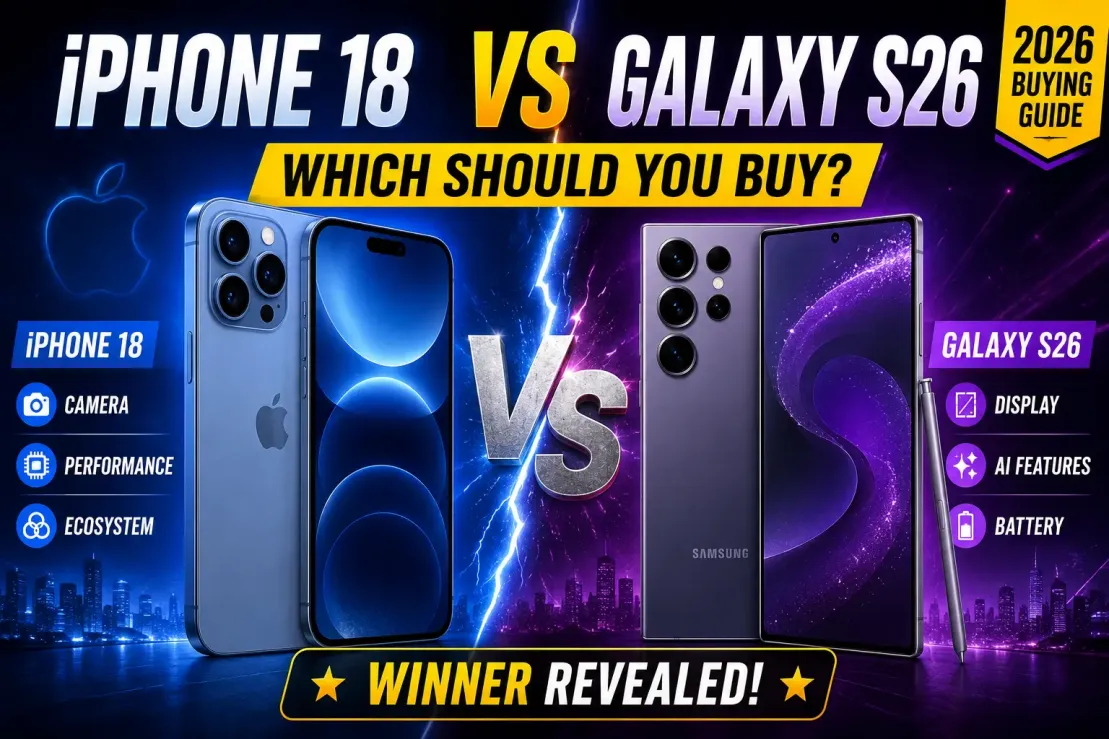
The 2026 Flagship Divide: iPhone 18 vs. Samsung Galaxy S26 Ultra
The modern smartphone industry has largely settled into a hardware plateau, a sustained period where year-over-year iterations often blur together in a haze of incremental processor bumps, software tweaks, and minor camera adjustments. Yet, the 2026 product cycle represents a fascinating and highly consequential divergence in corporate philosophy. Samsung and Apple, the two undisputed titans of the premium mobile sector, are no longer fighting the exact same battle. Instead, they are pushing their respective premium flagships—the Samsung Galaxy S26 Ultra and the upcoming iPhone 18 Pro Max—into highly specialised, almost opposing technological corners. iPhone 18 vs Samsung Galaxy S26
Evaluating these two monolithic devices requires looking far past the polished marketing copy and surface-level aesthetic changes. The true differentiation lies deep within their underlying architectures: in the silicon fabrication nodes, the optical supply chain complexities, the approach to on-device artificial intelligence, the macroeconomic pressures of memory pricing, and the physical characteristics of the display panels themselves.
The Galaxy S26 Ultra, released in March 2026, attempts to solve the very public problem of screen privacy while brute-forcing charging speeds and integrating third-party large language models deeply into its interface. Conversely, the iPhone 18 Pro Max, anticipated for a September 2026 launch, signals a massive internal restructuring for Apple. This includes a staggeringly expensive move to 2-nanometre silicon, the long-awaited debut of an in-house cellular modem, and a mechanically complex variable aperture camera system.
This comprehensive analysis deconstructs the technological, economic, and practical realities of both devices, offering an uncompromising look at how the flagship smartphone is being redefined in 2026.
The Display Paradigm: Optical Purity vs. Security Utility
For over a decade, the mandate for smartphone displays was remarkably straightforward: brighter, faster, and more pixel-dense. Both the iPhone 18 Pro Max and the Galaxy S26 Ultra satisfy these baseline requirements with ease, offering adaptive 1–120Hz refresh rates and peak brightness levels hovering near an astounding 3,000 nits. However, the defining characteristic of the 2026 display battle is not illumination or colour volume, but rather who is permitted to view the screen.
Samsung's Flex Magic Pixel Architecture
Samsung has fundamentally altered the display matrix of the Galaxy S26 Ultra with a hardware-level feature termed the "Privacy Display," powered by proprietary Flex Magic Pixel technology. This is not a software overlay that simply dims the screen, nor is it a basic polarisation filter; it is a physical alteration to the Black Matrix separating the red, green, and blue subpixels.
When activated, the panel precisely controls the emission and spread of light from individual subpixels—each only a few micrometres wide—restricting side-angle visibility. Independent verification by UL Solutions confirms that the display retains a mere 3.5% of its brightness at a 45-degree viewing angle, and drops below 0.9% at 60 degrees. To an onlooker sitting on a crowded commuter train, the device appears entirely black, while the primary user views the content clearly.
This represents a massive security upgrade for enterprise professionals, government workers, and privacy-conscious consumers interacting with sensitive financial data in public. Samsung intelligently paired this hardware with software contextual awareness, allowing the Privacy Display to trigger automatically when entering passwords or opening specific banking applications.
However, early market reception and digital behaviour analysis reveal the inherent trade-offs of manipulating display physics. Integrating a parallax barrier and altering the light-blocking structure occasionally results in a slight optical compromise. Real-world users have noted a subtle "fuzziness" or an oily sheen visible to the primary user, particularly over text and high-contrast interface elements. Furthermore, there have been documented complaints regarding the durability of the oleophobic coating paired with the Corning Gorilla Armor 2 anti-reflective glass, with some users reporting increased fingerprint retention compared to previous generations. The technology necessitates a delicate balance between absolute privacy and pristine optical clarity.
Apple's Refinement of the LTPO+ Canvas
Apple, by contrast, is expected to maintain its commitment to pristine, unadulterated optical clarity over hardware-level privacy mechanisms. The iPhone 18 Pro Max will reportedly feature a 6.9-inch LTPO+ OLED display, protected by a second-generation Ceramic Shield.
The most noticeable visual shift for the iPhone 18 Pro Max will be the substantial reduction of the Dynamic Island. Supply chain leaks and component analyses indicate that Apple has successfully engineered specific Face ID components—namely the flood illuminator—to operate beneath the active display area. This transition allows the visible camera cutout to shrink by an estimated 35%, reclaiming valuable pixel real estate and minimising the visual intrusion that has characterised iPhones since the 14 Pro.
By pushing components beneath the display, Apple is inching closer to the theoretical ideal of an uninterrupted slab of glass. Furthermore, the rear glass design is expected to shed its current two-tone appearance, moving toward a seamless, frosted finish across the entire backplate and MagSafe array, paired with a flatter titanium edge.
Best camera phones under 30000 in 2026 u should buy it without any fear
Get Extra 20% OFF
Launch your website today with ultra-fast, secure & premium hosting from Hostinger. Click to claim your deal!
Silicon Economics: The Leap to 2-Nanometre Fabrication
The processing cores driving these devices highlight a critical split in semiconductor manufacturing timelines. The raw performance capabilities of both devices are staggering, but the architectural pathways they take to achieve that computational density differ significantly. The physical limits of silicon are being tested, and the economic toll of manufacturing at the sub-3nm scale is reshaping the entire mobile industry.
Snapdragon 8 Elite Gen 5 (3nm)
The Galaxy S26 Ultra is powered by the Qualcomm Snapdragon 8 Elite Gen 5 for Galaxy, built on a highly optimised 3-nanometre architecture. Featuring an octa-core setup with dual performance cores clocking in at a blistering 4.74GHz (Oryon V3 Phoenix L) alongside six efficiency cores running at 3.62GHz (Oryon V3 Phoenix M), this chipset is designed for brute-force computational power. Samsung pairs this processing engine with a baseline of 12GB of LPDDR5X RAM, scaling up to 16GB in the 1TB storage variant.
The thermal demands of such high clock speeds are considerable. Qualcomm and Samsung have opted to achieve higher multi-core scores by targeting elevated clock speeds, which inherently increases power draw. To mitigate this, Samsung utilises extensive internal vapour chamber cooling systems, ensuring sustained performance during intensive 3D rendering and the heavy generative AI tasks facilitated by the One UI 8.5 environment. The performance is undeniably top-tier, but it relies on pushing a mature 3nm node to its absolute thermal and electrical limits.
Apple A20 Pro (2nm) and the WMCM Paradigm
The iPhone 18 Pro Max, however, crosses a historic threshold. The custom A20 Pro chipset will be one of the first consumer processors manufactured on TSMC’s bleeding-edge 2-nanometre (N2) node.
Moving to a smaller node architecture allows Apple to pack significantly more transistors into the exact same physical footprint. Industry analysts project the A20 Pro will deliver up to a 15% increase in raw speed while reducing power consumption by roughly 30% compared to the 3nm A19 Pro. But the node shrink is only half of the story.
Apple is expected to adopt Wafer-Level Multi-Chip Module (WMCM) packaging for the first time. This advanced technique integrates the System-on-Chip (SoC) and the DRAM directly at the wafer level, prior to being diced into individual chips. This eliminates the need for traditional substrates and interposers, bringing the memory physically closer to the processing cores. The result is a dramatic reduction in latency, superior signal integrity, and a massive boost in the bandwidth required for processing large, on-device artificial intelligence models without rapidly draining the battery.
This technological leap is heavily subsidised by immense capital expenditure. The initial yields of TSMC's 2nm chips are exceptionally expensive, with early supply chain estimates placing the per-chip cost near $280. Apple’s chip design strategy continues to focus heavily on performance efficiency rather than chasing the extreme 5GHz clock speeds seen in the Android ecosystem. By relying on architectural efficiency and custom core performance, Apple achieves comparable or superior results without the associated heat generation.
Optical Engineering: Variable Aperture vs. Megapixel Density
Smartphone photography has largely relied on computational processing over the last half-decade to compensate for the physical limitations of tiny glass lenses. Deep learning algorithms artificially blur backgrounds, synthesise multiple exposures for HDR, and sharpen details. In 2026, both Apple and Samsung are pushing physical optical hardware to its absolute limit, albeit in contrasting directions, attempting to solve analogue lighting problems with analogue hardware.
The Cost of Variable Light Control
Apple is expected to implement a variable aperture mechanism on the primary 48MP Fusion camera of the iPhone 18 Pro Max. This represents a profound shift in iPhone camera architecture. For years, iPhones have relied on fixed apertures (such as f/1.78) and utilised software algorithms to artificially separate subjects from backgrounds in Portrait Mode. A variable aperture allows the camera to physically adjust the size of the lens opening via mechanical blades, controlling light intake natively.
This mechanical flexibility allows the sensor to naturally compress depth of field in well-lit environments—creating authentic optical bokeh that does not struggle with edge detection around complex subjects like hair or transparent glass—while opening wide to capture maximum light in dark environments. Furthermore, reports suggest Apple may utilise a custom Lateral Overflow Integration Capacitor (LOFIC) sensor to boost HDR output, minimising overexposure in bright areas by allowing each pixel to store varying amounts of light in a single capture.
Sourcing this technology is proving to be a logistical and financial hurdle. Supply chain reports indicate that Apple is relying heavily on Chinese manufacturer Sunny Optical for up to 50% of these variable aperture modules, which carry an average selling price roughly 50% higher than the previous 7P fixed lenses. The sheer cost and manufacturing complexity of this tiny mechanical array explain why variable apertures have remained rare in the broader smartphone market.
Samsung’s Refined Quad-Camera Array
Samsung abandoned its brief experimentation with variable apertures years ago, opting instead to maximise sensor size, megapixel density, and fixed optical focal lengths. The Galaxy S26 Ultra features a monstrous 200MP primary sensor with an expanded, fixed aperture of f/1.4—a significant improvement over the f/1.7 aperture of its predecessors. This wider opening allows 47% more light to hit the sensor, drastically improving low-light shutter speeds and reducing motion blur in evening scenarios without relying solely on long-exposure night modes.
Furthermore, Samsung maintains a distinct, undeniable advantage in dedicated telephoto hardware. The S26 Ultra utilises a dual-telephoto system: a 10MP 3x optical zoom (f/2.4), and a high-resolution 50MP 5x periscope lens (f/2.9). Apple’s reliance on a single 48MP tetraprism lens for telephoto duties means Samsung retains the crown for versatile, long-range optical clarity, specifically at the intermediate 3x range where traditional portrait photography often occurs.
Get Extra 20% OFF
Launch your website today with ultra-fast, secure & premium hosting from Hostinger. Click to claim your deal!
Artificial Intelligence and the Evolution of the Assistant
The integration of Large Language Models (LLMs) into the core operating system is no longer a novelty; it is a foundational expectation for premium devices. How these models interact with the user, where the data is processed, and the ultimate utility they provide reveals deeply contrasting data philosophies between the two companies.
The Rebirth of Bixby via Perplexity
With the rollout of One UI 8.5, Samsung has radically overhauled its legacy Bixby assistant, a service historically relegated to basic device toggling and often actively disabled by users. The new iteration, dubbed "Bixby Live," is deeply integrated with the Perplexity LLM.
Instead of relying solely on a closed, internal knowledge base, complex queries are handed off to Perplexity for real-time web scraping, resulting in heavily researched, conversational responses complete with verifiable citations. This pivots Bixby from a simple utility into a profound research and conversational agent. Leaked interfaces reveal a dynamic overlay reminiscent of Google's Gemini Live, allowing users to share their screen context with the AI, discuss topics in real-time, or upload documents for multimodal analysis. Samsung is effectively bypassing Google's AI ecosystem on its own hardware, offering consumers a powerful, citation-backed LLM experience directly out of the box.
Apple Intelligence and Semantic Routing
Apple’s approach with iOS 20 and Apple Intelligence remains deeply rooted in ecosystem cohesion and data privacy. While ChatGPT is natively integrated for complex generational tasks and broad world knowledge, Apple places a massive emphasis on semantic, on-device processing.
The architecture of the A20 Pro chip allows Siri to maintain "onscreen awareness," understanding the context of the active application without transmitting visual data to the cloud. A user can prompt the device to "Send the email I drafted to April and Lilly," and the system understands the semantic relationship between the drafting application, the contact framework, and the messaging protocol. This privacy-first methodology restricts some of the free-flowing, hallucinatory web capabilities seen in cloud-based LLMs, but ensures that personal communications, photo metadata, and local application usage are analysed exclusively on the local hardware. Apple is betting that consumers value absolute data sovereignty over unconstrained AI generation.
The Connectivity Revolution: Escaping the Cell Tower
Perhaps the most significant, yet invisible, upgrade in the iPhone 18 Pro Max is the anticipated debut of Apple's in-house C2 5G modem. This hardware milestone marks the end of a tumultuous 15-year reliance on Qualcomm, fundamentally altering the iPhone's supply chain and connectivity architecture.
Owning the modem architecture allows Apple to govern power draw at the most fundamental baseband level. By controlling both the SoC and the modem, Apple can heavily optimise thermal performance and battery life, particularly in low-signal environments where traditional modems drain power aggressively searching for towers.
More importantly, the C2 modem supports NR-NTN (New Radio Non-Terrestrial Networks). This protocol effectively treats low-earth orbit satellites as distant cell towers. Unlike older, rudimentary iterations of emergency satellite connectivity that required users to hold their phones toward the sky and follow on-screen tracking prompts, NR-NTN operates seamlessly in the background. When terrestrial 5G drops, the device can automatically route data for iMessage, Apple Maps, and third-party APIs through satellite networks without manual intervention. This transforms satellite connectivity from an emergency lifeline into a standard data pipeline for remote connectivity.
Samsung’s S26 Ultra provides exceptional terrestrial connectivity, including support for the latest Wi-Fi 7 standards, Bluetooth 6.0, and Ultra Wideband (UWB). It relies on Qualcomm's robust, off-the-shelf modem solutions, which are historically excellent at maintaining fast 5G throughput. However, without the deep, seamless hardware-level satellite integration Apple is pioneering with its proprietary radio hardware, Samsung users in remote areas remain tethered to traditional cellular infrastructure.
Thermal Management, Endurance, and Charging Infrastructure
Powering high-density LTPO displays, neural engines processing real-time AI, and mechanical optical systems requires robust energy storage and highly efficient thermal dissipation.
The Galaxy S26 Ultra houses a 5,000mAh lithium-ion battery, a standard capacity for the Ultra line over the past few iterations. However, Samsung has finally addressed a long-standing criticism regarding charging velocity, upgrading the wired charging protocol to an impressive 60W. This allows the device to reach a 75% charge in just 30 minutes, drastically reducing downtime for heavy users. It also maintains 25W wireless charging and 4.5W reverse wireless charging capabilities, ensuring parity with the broader Android flagship ecosystem.
Apple is preparing to counter not with charging speed, but with sheer endurance. The iPhone 18 Pro Max is rumoured to feature an expanded physical battery capacity, ranging between 5,100mAh and 5,200mAh. When this physically larger cell is paired with the estimated 30% efficiency gains of the 2nm A20 Pro chip, the highly integrated internal power management of the new C2 modem, and the refined LTPO+ display, the iPhone 18 Pro Max is positioned to set industry records for continuous screen-on time.
While Apple’s charging speeds traditionally lag behind Android competitors—likely remaining conservative around the 35W to 40W mark—the raw longevity of the device may render midday charging entirely obsolete. Apple's philosophy dictates that a phone that lasts two days requires less anxiety over how fast it recharges.
Get Extra 20% OFF
Launch your website today with ultra-fast, secure & premium hosting from Hostinger. Click to claim your deal!
Macroeconomics of 2026 Flagships: Pricing and Strategy
The financial landscape of the 2026 smartphone market is defined by soaring component costs and intense supply chain pressures. A phenomenon industry insiders refer to as the "RAMpocalypse" has seen high-bandwidth memory pricing surge due to the global demand for AI servers. Simultaneously, the yield costs of cutting-edge 2nm silicon and complex mechanical optical assemblies are draining profit margins.
Samsung reacted to these macroeconomic pressures by raising the entry price of its base Galaxy S26 and S26+ models by $100. However, to maintain its competitive edge in the ultra-premium sector, the company held the base price of the Galaxy S26 Ultra at $1,299 for the 256GB model, passing the cost increases only to the 512GB and 1TB storage tiers.
Apple finds itself in a significantly tighter economic position. The combination of the estimated $280 A20 Pro processor and the 50% premium on Sunny Optical's variable aperture lenses makes avoiding a price hike exceedingly difficult. Financial analysts heavily debate whether Apple will absorb these costs internally to maintain market share or push the starting price of the iPhone 18 Pro Max to $1,299 (a $100 increase from previous generations), aligning it perfectly with the S26 Ultra.
Fascinatingly, Apple is reportedly altering its entire release cadence to highlight the Pro models and manage component supplies. Industry leaks indicate a radical "split-launch" strategy: the iPhone 18 Pro, Pro Max, and a rumoured ultra-premium "iPhone Fold" will launch in the Autumn of 2026, while the standard base-model iPhone 18 and iPhone 18e will be delayed until the Spring of 2027. This ensures that holiday buyers evaluating flagship devices will have their attention directed solely toward Apple's highest-margin, most technologically advanced hardware, free from the cannibalisation of a cheaper base model.
User Reception and Real-World Friction
Digital sentiment analysis and consumer feedback from early adopters of the Galaxy S26 Ultra highlight the friction points that inevitably occur when pushing new hardware paradigms.
While the S26 Ultra is broadly praised for its anti-reflective coating and flat-edge design, a vocal subset of users on technical forums report fatigue regarding the Privacy Display. The feature, while technically impressive, causes mild eye strain for some users due to the way the display refracts light when viewed directly, creating an almost "fuzzy" interpretation of fine text. Furthermore, inconsistent quality control regarding the internal speakers—with some units exhibiting a slight hissing sound—has frustrated buyers paying a $1,300 premium.
There is also a lingering sentiment of nostalgia among long-term Samsung users. The continuous removal of legacy features—expandable microSD storage, MST for payments, and the headphone jack—while charging premium prices leaves some power users feeling the "Ultra" moniker carries less weight than the "Note" devices of the past.
Apple users, anticipating the iPhone 18 Pro Max, are largely braced for the inevitable price hike. The primary concern within the Apple ecosystem is whether the variable aperture lens will provide a tangible benefit to the average user, or if it will be a fragile mechanical component prone to failure. However, the promise of true multi-day battery life driven by the 2nm architecture remains the most highly anticipated upgrade across consumer demographics.
Final Analysis: Diverging Paths of Excellence
Evaluating the premium smartphone landscape in 2026 reveals a fascinating departure from the homogenous spec wars of the early decade. The decision between the iPhone 18 Pro Max and the Samsung Galaxy S26 Ultra relies entirely on how the user fundamentally interacts with the digital world.
For the enterprise professional navigating dense public transit, or the power user prioritising strict data hygiene in public, the Galaxy S26 Ultra provides an unrivaled suite of physical and digital tools. Its hardware-level Privacy Display physically shields sensitive information from prying eyes, while the long-overdue 60W charging architecture ensures the device is rarely tethered to a wall. Paired with the conversational prowess of the Perplexity LLM integrated directly into Bixby Live, it serves as a deeply pragmatic, outward-facing workhorse capable of heavy research and instant communication.
Conversely, the iPhone 18 Pro Max represents a triumph of internal vertical integration. By securing TSMC's 2nm nodes, deploying a proprietary satellite-capable cellular modem, and investing heavily in physically complex variable aperture optics, Apple is building a device focused on absolute endurance, creative control, and ubiquitous, invisible connectivity. It is a device engineered for seamless transitions—between terrestrial cellular and orbital satellite networks, between deep optical bokeh and wide-light intake, and between local processing and cloud intelligence.
Both devices command their respective ecosystems with unparalleled authority, proving that while the basic rectangular form factor of the smartphone has stabilised, the architectural ambition and silicon engineering driving it forward has never been more aggressive.







💬 Comments (0)
🔒 Please login to post a comment.
Login Now