
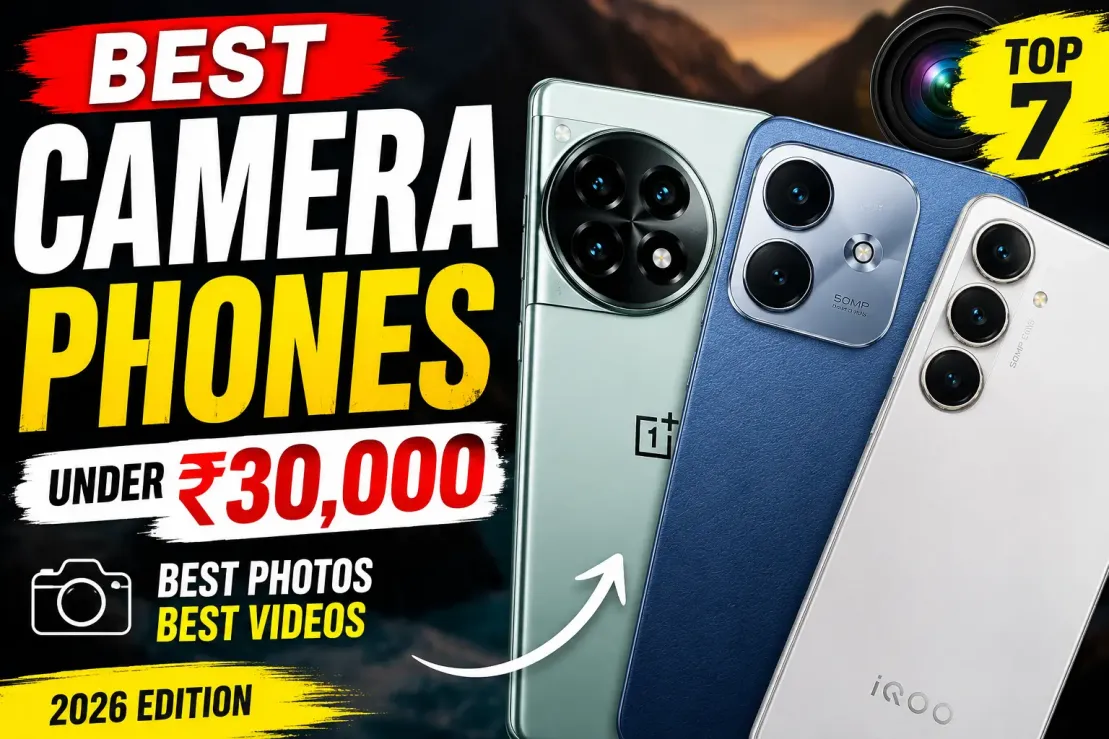
Best Camera Phones Under ₹30,000 in 2026: The Mid-Range Smartphones That Finally Feel Flagship
There was a time when “budget camera phone” meant compromise. You either accepted weak low-light photos, unstable video, poor processing, or cameras that looked impressive on paper but collapsed the moment the sun disappeared.
That distinction has started to blur — fast.
The ₹25,000–₹30,000 segment has quietly become one of the most competitive categories in the smartphone industry. Not because brands suddenly became generous, but because the economics of flagship innovation changed. Features once locked behind ₹70,000 devices now trickle down within a year or two. Better image sensors, computational photography, AI-assisted stabilization, and flagship-grade chipsets have reached phones students, creators, and first-time enthusiasts can realistically buy.
And that shift matters.
For many college students, Instagram creators, YouTube Shorts editors, and mobile gamers in India, the phone is no longer just a communication device. It is the primary camera, editing machine, streaming screen, and social publishing tool rolled into one slab of glass and silicon.
The modern mid-range smartphone is increasingly designed around that reality.
So instead of chasing megapixel numbers or flashy marketing language, this guide focuses on something more useful: which phones actually deliver the best real-world camera experience under ₹30,000 — while still handling gaming, battery life, and daily performance without feeling compromised six months later.
What Actually Makes a Great Camera Phone in 2026?
A surprisingly large number of buyers still fall for the “108MP” trap.
Megapixels matter far less than sensor quality, image processing, stabilization, dynamic range handling, and software tuning. In fact, some of the best camera phones in this segment rely heavily on computational photography rather than raw hardware alone.
The phones worth considering in 2026 typically get four things right:
- Reliable HDR processing
- Strong low-light consistency
- Natural skin tones
- Stable video performance
Everything else is secondary.
There’s also another shift happening beneath the surface: AI image pipelines.
Companies like Google, Samsung, and OnePlus increasingly rely on machine-learning-assisted processing to improve exposure balance, remove noise, sharpen details, and stabilize handheld footage.
Some brands do this subtly. Others oversaturate images into social-media-ready hyperreality.
The difference becomes obvious once you compare photos side by side.
The Best Camera Phones Under ₹30,000 Right Now
| Phone | Best For | Camera Strength | Gaming Performance | Weakness |
|---|---|---|---|---|
| OnePlus Nord CE 6 | Balanced overall experience | Natural daylight shots | Excellent | Average ultrawide |
| iQOO Neo 10 | Gaming + camera balance | Strong video stabilization | Flagship-grade | UI can feel cluttered |
| Nothing Phone (3a) | Social media creators | Distinct image tuning | Very good | Low-light inconsistency |
| Realme GT Series | Performance enthusiasts | Sharp detail capture | Excellent | Aggressive processing |
| Samsung Galaxy A Series | Reliable photography | Consistent colors | Moderate | Slower charging |
|
Affiliate Disclaimer Some links on this page may be affiliate links, including links from the Amazon Associates Program. This means we may earn a small commission if you purchase through these links, at no extra cost to you. Exclusive Deal
Get Extra 20% OFFLaunch your website today with ultra-fast, secure & premium hosting from Hostinger. Click to claim your deal! Our recommendations are based on independent research, product analysis, and editorial opinion. Affiliate partnerships do not influence our reviews, rankings, or recommendations. Prices and availability may change over time. |
OnePlus Continues to Understand the “Everyday Camera” Better Than Most
The reason many users gravitate toward the Nord series isn’t because it dominates benchmarks. It’s because the camera output feels dependable.
That matters more than reviewers sometimes acknowledge.
The average user is not manually tweaking ISO levels or shooting RAW photos. They’re taking quick shots in cafés, classrooms, concerts, and late-night street environments. A good camera phone today succeeds by reducing friction between capturing and sharing.
The latest Nord devices lean heavily into that philosophy.
Skin tones generally avoid the exaggerated contrast many Chinese brands still push aggressively. Exposure control remains stable in mixed lighting. Video stabilization has improved noticeably over the last two generations.
And importantly, the phones don’t overheat under sustained gaming sessions — something many “performance-first” devices still struggle with.
For students juggling BGMI sessions, Instagram uploads, and daily multitasking, that balance matters more than isolated camera scores.
Why iQOO Phones Are Dominating Among Young Gamers
There’s a reason iQOO’s popularity exploded across Indian campuses.
The company aggressively targeted users who wanted flagship-grade performance without flagship pricing. What started as a gaming-focused brand has quietly evolved into one of the strongest value propositions in the Android ecosystem.
Its recent devices combine:
- High-refresh AMOLED displays
- Powerful Snapdragon chipsets
- Strong thermal management
- Surprisingly capable main cameras
That last part often gets overlooked.
Earlier gaming phones treated cameras almost like an obligation. Modern iQOO devices no longer do. Their video stabilization and dynamic range processing have improved substantially, especially in daylight shooting.
For creators shooting vertical content, Reels, or casual vlogs, this matters.
The camera system may not match premium flagships from Apple or Google, but within this price bracket, the gap has narrowed more than most buyers realize.
The Strange Rise of “Social-Media Cameras”
Not all camera phones are optimized for realism anymore.
Some are optimized for engagement.
Get Extra 20% OFF
Launch your website today with ultra-fast, secure & premium hosting from Hostinger. Click to claim your deal!
That sounds cynical, but it reflects how people actually use phones today. Brands increasingly tune cameras around what performs well on platforms like Instagram, Snapchat, and TikTok rather than what appears technically accurate.
Oversaturated skies. Warmer skin tones. Sharpened facial details. High-contrast night shots.
Many users prefer that aesthetic.
Phones like the Nothing Phone series lean into this identity-driven visual style. Photos often feel more cinematic than clinically accurate. The hardware itself matters, but the brand’s image-processing philosophy shapes the experience even more.
For creators building personal aesthetics online, this becomes a surprisingly important buying factor.
Mobile Photography Has Become More Computational Than Optical
The biggest misunderstanding in smartphone photography is assuming cameras improved purely because sensors got larger.
Software now plays an equally important role.
Modern Android phones constantly process scenes before you even press the shutter button. AI models evaluate lighting, motion, facial contours, object recognition, and exposure stacking in real time.
That’s why two phones using similar Sony sensors can produce dramatically different images.
Some prioritize realism. Others prioritize brightness. Some aggressively smooth skin. Others intentionally preserve grain for texture authenticity.
Increasingly, the “camera quality” conversation is actually a software philosophy conversation.
And buyers are becoming more aware of it.
The Gaming Factor Changes Everything
A phone cannot realistically succeed in India’s sub-₹30,000 market anymore if it ignores gaming performance.
Even photography-focused users expect:
- Stable thermals
- High frame rates
- Good battery endurance
- Fast charging
- Efficient multitasking
That creates engineering trade-offs.
Larger camera sensors consume internal space. Better cooling systems also require space. Bigger batteries increase thickness. High-performance chipsets generate heat that affects camera stability during 4K recording.
Mid-range smartphones are now balancing all these pressures simultaneously.
Get Extra 20% OFF
Launch your website today with ultra-fast, secure & premium hosting from Hostinger. Click to claim your deal!
Some brands prioritize camera consistency. Others prioritize gaming benchmarks. A few are finally managing both reasonably well.
That’s why this segment feels unusually competitive in 2026.
Are Mid-Range Phones Replacing Flagships for Most Users?
Quietly, yes.
The smartphone industry rarely says this directly because premium devices remain enormously profitable, but the innovation gap between ₹30,000 phones and ₹80,000 phones has narrowed significantly for average consumers.
For social media uploads, casual photography, YouTube Shorts, gaming, streaming, and daily multitasking, mid-range devices now satisfy most real-world needs.
Where flagships still dominate:
- Advanced zoom systems
- Professional video workflows
- Superior low-light consistency
- Longer software support
- Premium build materials
- AI ecosystem integrations
But for many younger buyers, those differences no longer justify spending three times more.
That market reality explains why brands are fighting so aggressively in this category.
Pros and Cons of Buying a Camera Phone Under ₹30,000
Pros
- Excellent value-to-performance ratio
- Flagship-like displays and processors
- Strong computational photography
- Good gaming support
- Fast charging becoming standard
- Ideal for students and creators
Cons
- Ultrawide cameras often weaker
- Low-light consistency still inconsistent
- Long-term software support varies
- Video quality trails true flagships
- Some brands overprocess photos aggressively
What Students and Young Creators Should Prioritize
If you’re buying primarily for photography and content creation, prioritize this order:
- Main camera quality
- Video stabilization
- Thermal management
- Battery endurance
- Display quality
- Processor performance
- Charging speed
The mistake many buyers make is focusing entirely on benchmark numbers while ignoring how the phone behaves during daily camera usage.
A slightly weaker chipset with better image processing often delivers a better long-term experience than a “gaming monster” with inconsistent cameras.
Suggestions for students who want to purchase laptop
The Mid-Range Smartphone Has Become the Most Interesting Category in Tech
For years, flagship phones dominated attention because they represented technological ambition.
Now the real innovation war is happening lower down the pricing ladder.
That’s where brands experiment with AI imaging, aggressive chipset pricing, creator-focused software, gaming optimizations, and battery technologies aimed at users who actually rely on smartphones as their primary computing device.
The result is a market where ₹30,000 phones increasingly feel less like compromises and more like practical flagship alternatives.
And for students, young creators, and photography enthusiasts, that may be the most important shift in the smartphone industry right now.






💬 Comments (0)
🔒 Please login to post a comment.
Login Now