
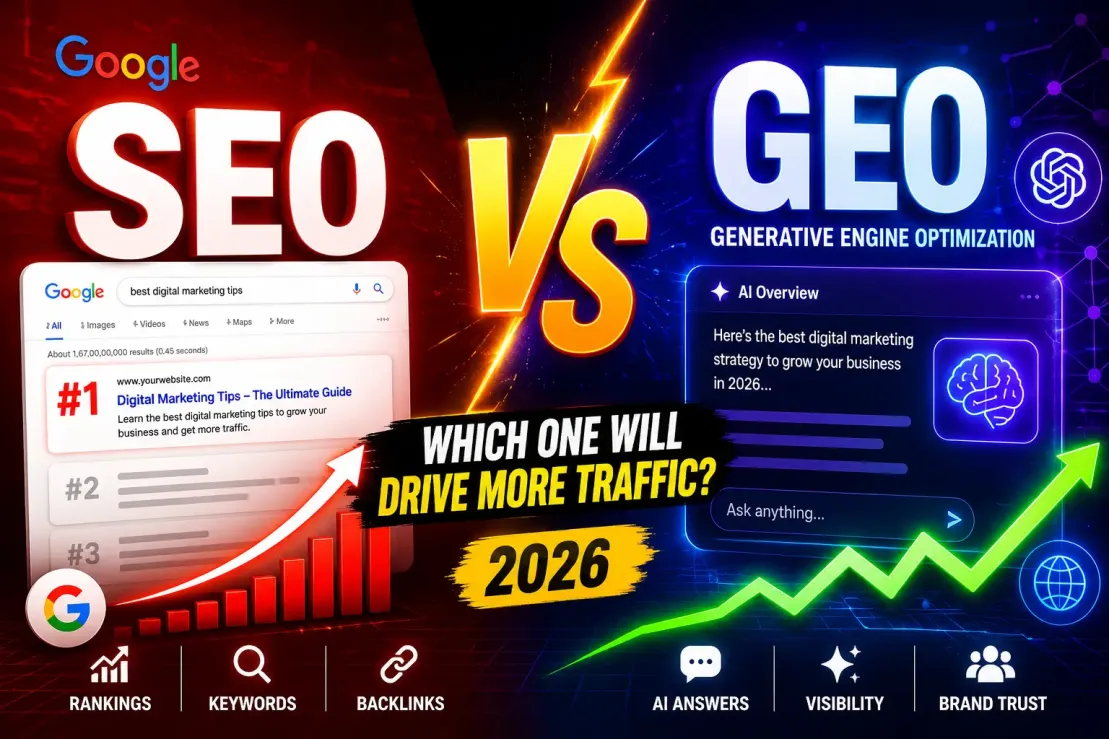
SEO vs GEO: Which One Will Drive More Traffic in the AI Search Era?
A few years ago, the question would have sounded strange.
Why compare SEO with anything?
If a business wanted traffic, it optimized for search engines. If a blogger wanted readers, they optimized for search engines. If a SaaS company wanted signups, they optimized for search engines.
Search was the gateway.
Now the conversation feels different.
Users increasingly ask questions directly inside AI systems. They receive synthesized answers instead of scrolling through ten blue links. They compare products inside conversational interfaces. They ask follow-up questions without ever opening another tab.
The result is a new debate spreading across marketing teams, SEO communities, agency boardrooms, and founder circles:
Will SEO continue to dominate organic traffic, or will GEO become the primary visibility strategy?
The answer is more nuanced than most social media posts make it seem.
And if you're responsible for growing traffic in 2026 and beyond, understanding that nuance matters.
First, What Exactly Is SEO?
Search Engine Optimization (SEO) is the practice of improving a website's visibility within traditional search engines.
When someone searches on Google, Bing, or other search platforms, SEO helps pages appear higher in organic results.
For decades, the model has remained relatively consistent:
- User searches
- Search engine ranks pages
- User clicks a result
- Website receives traffic
The mechanics evolved dramatically, but the basic workflow survived.
Modern SEO includes:
- Technical optimization
- Content quality
- Site architecture
- User experience
- Entity optimization
- Internal linking
- Topical authority
- Structured data
- Brand trust signals
The goal remains straightforward:
Earn visibility, attract clicks, and bring users to your website.
GEO Emerged Because Search Behavior Changed
Generative Engine Optimization (GEO) exists because users increasingly interact with AI-generated answers instead of traditional search listings.
Platforms such as ChatGPT, Perplexity AI, Google Gemini, and AI-powered search experiences inside Google are changing how information is discovered.
Rather than presenting ten competing pages, these systems often generate a single synthesized response.
That creates a new challenge.
Instead of asking:
"How do I rank number one?"
Marketers increasingly ask:
"How do I become one of the sources the AI chooses?"
That's where GEO enters the conversation.
GEO Is Not Really About Rankings
One misunderstanding appears constantly.
People treat GEO as if it's simply "SEO with a new name."
It isn't.
The primary objective shifts.
Traditional SEO focuses on rankings.
GEO focuses on inclusion, citation, referenceability, and entity recognition within AI-generated responses.
A generative engine doesn't always think in rankings.
It evaluates:
Get Extra 20% OFF
Launch your website today with ultra-fast, secure & premium hosting from Hostinger. Click to claim your deal!
- Authority
- Consistency
- Context
- Trust signals
- Entity relationships
- Citation quality
- Semantic relevance
In many cases, AI systems are trying to determine:
"Which source seems most reliable for answering this question?"
That is fundamentally different from ranking a list of pages.
The Traffic Question Is More Complicated Than It Looks
The phrase "Which drives more traffic?" sounds simple.
But traffic itself is changing.
Historically, traffic meant:
- Website visits
- Page views
- Sessions
- Click-through rates
Today, visibility can exist without a click.
A user might:
- Read an AI-generated answer
- Compare products
- Learn a concept
- Make a decision
...without visiting a single website.
That creates a strange reality.
A brand can become highly visible while receiving fewer direct visits.
For marketers raised in traditional SEO, this feels uncomfortable.
Visibility without traffic seems almost contradictory.
Yet that's increasingly how AI discovery works.
SEO Still Delivers the Largest Traffic Volumes
For most websites today, SEO remains the strongest driver of organic traffic.
Not because GEO is unimportant.
But because search engines still process billions of user queries that result in actual website clicks.
People continue searching for:
- Product reviews
- Tutorials
- Local businesses
- News
- Comparisons
- Educational content
- Software recommendations
And in many of these categories, users still want to explore multiple sources.
Traditional search behavior hasn't disappeared.
It's evolving rather than collapsing.
For publishers, bloggers, affiliate marketers, and content-driven businesses, SEO continues to produce the majority of measurable organic visits.
Where GEO Is Quietly Becoming Powerful
The more interesting question isn't where GEO wins today.
It's where GEO is gaining influence.
Consider a user asking:
"What's the best project management software for remote teams?"
An AI system may generate a detailed answer mentioning several products.
If your company is cited inside that response, you gain visibility before the user even considers opening a website.
That's powerful.
Especially because many purchase journeys begin with research rather than transactions.
GEO increasingly affects:
- Brand discovery
- Product awareness
- Thought leadership
- Expert recognition
- Entity authority
In some cases, being mentioned by AI may influence a purchasing decision more than ranking fifth on a search results page.
SEO vs GEO: The Core Differences
| Factor | SEO | GEO |
|---|---|---|
| Primary Goal | Earn rankings and clicks | Earn citations and AI visibility |
| Traffic Source | Search engine results | AI-generated answers |
| User Journey | Search → Click → Website | Question → AI Answer → Optional Visit |
| Success Metric | Organic traffic | Mentions, citations, authority |
| Optimization Focus | Pages and rankings | Entities and trusted information |
| Content Structure | Search-focused | Answer-focused |
| Brand Importance | Important | Extremely important |
What stands out is that neither replaces the other.
They solve different visibility problems.
Get Extra 20% OFF
Launch your website today with ultra-fast, secure & premium hosting from Hostinger. Click to claim your deal!
The Real Winners Will Combine Both
Many online debates assume a winner must emerge.
Reality is usually less dramatic.
The companies adapting fastest aren't abandoning SEO.
They're expanding beyond it.
The strongest strategy increasingly looks like this:
Build Traditional Search Authority
Continue investing in:
- Technical SEO
- Site speed
- Internal linking
- Content quality
- Topical depth
These remain foundational.
Without authority, AI systems are less likely to trust your content anyway.
Create Citation-Friendly Content
AI systems often favor content that is:
- Well structured
- Factually clear
- Context rich
- Expert-driven
- Entity-focused
Content buried beneath promotional language tends to perform poorly in AI environments.
Become a Recognized Entity
This is where many marketers underestimate the shift.
AI systems increasingly understand:
- Companies
- People
- Products
- Organizations
- Technologies
as entities rather than simple keywords.
A trusted brand entity often outperforms a perfectly optimized page.
Why Many Traffic Reports May Become Misleading
An interesting side effect of GEO is measurement.
Traditional analytics tools were built around visits.
But what happens when visibility occurs before the click?
A company might appear:
- Inside AI answers
- In conversational search
- Across AI citations
- Within recommendation systems
Yet receive fewer recorded sessions.
Some businesses will mistakenly assume they're losing influence.
In reality, their visibility may be expanding.
This creates a challenge for marketing teams.
Metrics that worked for fifteen years may no longer tell the full story.
The industry is still figuring out how to measure AI-era discovery accurately.
Affiliate Marketers Should Pay Particular Attention
Affiliate websites face a unique situation.
Historically, search traffic powered entire business models.
Users searched:
- Best laptops
- Best hosting providers
- Best VPN services
- Best project management tools
Then clicked comparison articles.
AI-generated answers now increasingly summarize these comparisons directly.
That doesn't mean affiliate marketing disappears.
It means thin comparison content becomes harder to sustain.
The sites likely to thrive are those offering:
- Original testing
- Real experience
- Unique insights
- First-hand evaluation
- Expert analysis
AI can summarize public information.
It struggles more with genuine experience.
Get Extra 20% OFF
Launch your website today with ultra-fast, secure & premium hosting from Hostinger. Click to claim your deal!
That's becoming a competitive advantage.
What Google's AI Direction Reveals
Perhaps the clearest signal comes from Google's own evolution.
Google isn't abandoning search.
It's blending search and AI.
Traditional rankings still exist.
AI-generated summaries increasingly exist alongside them.
That tells us something important.
The future probably isn't:
SEO replaces GEO
or
GEO replaces SEO
Instead, it looks more like:
SEO + GEO = Modern Search Visibility
Businesses treating these as separate battles may miss the bigger picture.
Pros and Cons of SEO
Pros
- Proven traffic channel
- Measurable results
- Strong commercial intent
- Long-term asset creation
- Supports brand growth
Cons
- Increasing competition
- Algorithm volatility
- Slower results
- Dependence on search platforms
Pros and Cons of GEO
Pros
- Growing visibility opportunity
- Early-mover advantage
- Strong brand positioning
- Aligns with AI search trends
- Can influence users before clicks occur
Cons
- Limited measurement standards
- Less predictable optimization signals
- Fewer established best practices
- May not always generate direct traffic
So, Which One Will Drive More Traffic?
The short answer:
SEO will still drive more direct website traffic for most businesses throughout the near future.
However, GEO is increasingly influencing how users discover brands, products, expertise, and information before they ever reach a website.
That distinction matters.
If your goal is purely measured sessions and clicks, SEO remains dominant.
If your goal is long-term visibility across emerging AI ecosystems, GEO deserves serious attention.
The smartest marketers aren't choosing sides.
They're recognizing that search itself is becoming broader than search engines.
Final Conclusion for Website Users
The debate around SEO versus GEO often assumes a dramatic handoff is underway, as if one system must replace the other.
Technology rarely evolves that cleanly.
What usually happens is layering.
New behavior emerges before old behavior disappears.
People still search. They also ask AI.
They still click websites. They also trust synthesized answers.
For businesses, publishers, creators, and marketers, the opportunity isn't choosing between SEO and GEO.
It's understanding how both fit into the same evolving discovery ecosystem.
The websites that thrive over the next few years will likely be the ones that remain genuinely useful to humans while becoming increasingly understandable to machines.
That sounds simple.
In practice, it may become the defining marketing challenge of the AI search era.




💬 Comments (0)
🔒 Please login to post a comment.
Login Now