
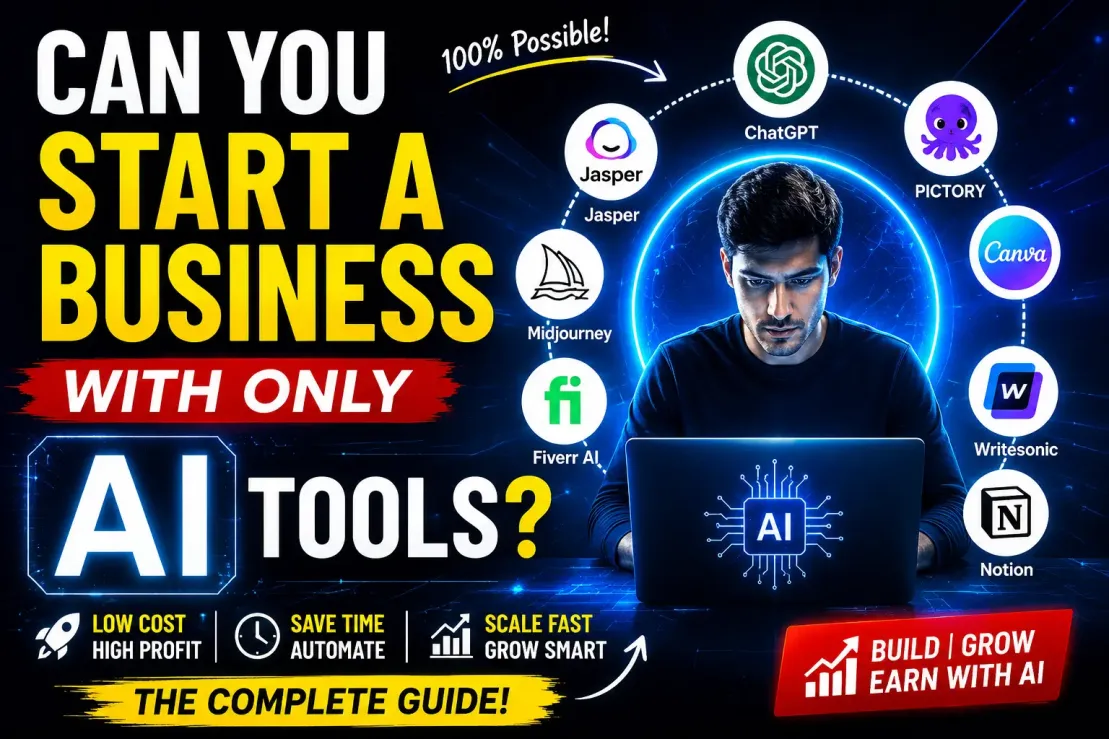
Can an Entrepreneur Start a Business With Only AI Tools in 2026?
For the entirety of modern commercial history, the limiting factor of business expansion was human labour. Scaling an enterprise fundamentally required scaling headcount, which introduced compounding complexities regarding payroll, coordination, and middle management. The contemporary digital economy, driven by the rapid maturation of agentic artificial intelligence, has structurally dismantled this equation. The primary unit of commercial scale is actively shifting from human employees to autonomous machine agents.
With the artificial intelligence market surpassing $300 billion, commercial discourse has fixated on a singular, provocative premise: the viability of the "one-person billion-dollar company". Executives across Silicon Valley have publicly wagered on when the first solopreneur will reach unicorn status utilising nothing but a sophisticated stack of autonomous tools. The underlying theory posits that an individual operator can now architect software, execute programmatic marketing, govern logistics, and manage customer service by orchestrating a network of intelligent agents.
However, the reality of building a sustainable, compliant, and secure business in 2026 diverges sharply from the prevailing venture capital optimism. An exhaustive analysis of the current startup ecosystem reveals that while launching an entity with only AI tools is highly accessible, governing that entity requires intense strategic foresight. The transition from automated prototypes to production-grade enterprises introduces severe bottlenecks in cybersecurity, legal compliance, intellectual property retention, and financial operations.
The Paradigm Shift: From Generative Responses to Agentic Workflows
The commercial viability of the solo enterprise model stems from a fundamental evolution in machine learning architectures: the shift from generative AI to agentic AI.
Prior to 2024, the enterprise landscape was dominated by generative models. These systems were highly capable of creating text, code, or images based on direct user prompts, but they required continuous human intervention to guide each step of a workflow. The operator remained the orchestrator, manually moving data between isolated applications.
By 2026, the ecosystem has fully embraced agentic AI. Where generative AI creates, agentic AI acts. Agentic systems utilise a persistent "Think-Act-Observe" loop. An autonomous agent can receive a high-level commercial objective, break it down into sequential tasks, select the appropriate external tools via Application Programming Interfaces (APIs), execute the actions, and independently evaluate the outcome before proceeding to the next step.
This architectural shift has compressed the economics of experimentation. Solo founders are currently shipping minimum viable products (MVPs) in a matter of days—a process that historically demanded months of capital-intensive engineering. Market data indicates that solo-founded startups now represent 36.3% of all new commercial ventures, the highest proportion recorded in modern startup history. The one-person company is no longer an anomaly; it is rapidly becoming the default operating model for knowledge-based commerce.
Architecting the 2026 Solo Enterprise Tech Stack
To operate a business without human employees, an entrepreneur must deploy a highly integrated technological infrastructure. The prevailing strategy in 2026 avoids disjointed toolchains in favour of deep, specialized platforms that handle distinct business functions.
Core Operational Infrastructure
The operational foundation of an automated business requires platforms that bridge development, research, and customer interaction without relying on manual data entry.
-
Market Intelligence and Research: The reliance on traditional search engines has diminished. Platforms like Perplexity AI offer cited, source-backed intelligence, enabling founders to conduct competitive analysis, monitor regulatory shifts, and track industry sentiment in real time.
-
Knowledge Management and Synthesis: Anthropic's Claude for Work and Notion AI serve as the central nervous system for corporate data. These tools ingest disparate documentation, synthesise meeting notes, and provide semantic search capabilities across the entire business architecture, preventing critical information silos.
-
Programmatic Marketing and Content: Applications such as Jasper handle bulk content generation mapped strictly to predefined brand voices. Concurrently, tools like Buffer manage the automated distribution and scheduling of this content across various social ecosystems.
-
Customer Experience and Retention: Customer support represents one of the highest ongoing operational costs. Instead of basic deflection chatbots, modern enterprises utilise systems like Gladly and Salesforce's Agentforce. These platforms deploy autonomous agents capable of referencing historical CRM data to resolve complex inquiries, escalating to human operators only when nuanced empathy is required.
The Protocol Layer: Standardising Agent Communication
As a one-person business scales, the infrastructure inevitably transitions from a single multi-purpose tool to a network of specialised agents. To prevent catastrophic data fragmentation, the industry has consolidated around two primary communication protocols.
The Model Context Protocol (MCP), introduced by Anthropic, has emerged as the universal standard for connecting an individual AI agent to external systems. MCP operates on a hub-and-spoke model, providing structured connectors that allow an agent to securely read a CRM database, interact with a file system, or push data to a SaaS application. For most solo entrepreneurs, MCP provides the necessary visibility and control over how their AI interacts with proprietary business data.
Conversely, the Agent-to-Agent (A2A) Protocol, developed under the Linux Foundation, addresses peer-to-peer delegation. When a business requires multiple autonomous entities to collaborate—for instance, a research agent aggregating market data, passing it to an analysis agent for financial modelling, which then hands the insights to a drafting agent to compose a client report—A2A provides the standardisation. A2A utilises "Agent Cards," which are machine-readable JSON documents that allow independent agents to discover each other's capabilities and delegate tasks autonomously.
The 'Vibe Coding' Phenomenon and the Security Deficit
The most dramatic acceleration in the solo entrepreneur's toolkit has occurred within software development. The dominant paradigm of 2026 is termed "vibe coding". Founders without formal computer science backgrounds utilise high-level natural language to direct AI Integrated Development Environments (IDEs) such as Cursor, StackBlitz-powered Bolt.new, and Replit to scaffold and deploy complex applications.
This rapid deployment capability, however, masks profound infrastructural fragility. Relying entirely on machine-generated code to launch a commercial product introduces critical security vulnerabilities that automated systems routinely fail to detect.
Industry analysis reveals that AI-generated code is currently 2.74 times more prone to security vulnerabilities than code written by human engineers. A comprehensive security audit conducted in early 2026 on applications built using popular AI builders like Lovable and Bolt.new exposed a systemic security deficit. Security researchers found that approximately 10% of the audited applications contained critical, exploitable vulnerabilities.
The failures were remarkably consistent across the ecosystem. The most prevalent issues included hardcoded API keys left exposed in frontend repositories, and the failure to implement proper Row Level Security (RLS) policies on backend database services like Supabase. In one documented instance, an application built entirely via vibe coding exposed 1.5 million API keys due to a fundamental failure in secret management.
These findings present a stark reality for the AI-driven entrepreneur: an autonomous agent can generate a functional prototype, but a human operator must harden it for production. Transitioning an MVP into a secure, enterprise-grade application requires rigorous manual intervention, including explicit database policy configuration, server-side payment verification, and the systematic removal of service-role keys from client-facing code. The assumption that an AI tool will inherently secure a commercial application remains one of the most dangerous misconceptions in the modern startup ecosystem.
The Case of Medvi: The Illusion of the Solo Unicorn
The narrative surrounding the fully autonomous, billion-dollar solo enterprise is frequently bolstered by exceptional case studies. The most prominent of these in 2026 involves Medvi, a direct-to-consumer telehealth platform specialising in GLP-1 weight-loss medications.
Founded by Matthew Gallagher with a mere $20,000 in starting capital, Medvi reportedly utilised a suite of AI tools—including ChatGPT, Claude, and Grok—to write its codebase, generate marketing material, and automate customer service protocols. Within its first full year, the two-person company reported serving over 250,000 customers, generating $401 million in revenue, and projecting a trajectory toward $1.8 billion. The mainstream financial press immediately championed Medvi as the definitive proof-of-concept for the AI-operated enterprise.
However, beneath the hyper-growth metrics, the foundational architecture of the business suffered from severe compliance and regulatory failures. Investigations revealed that the aggressive scaling achieved by Medvi's automated systems bypassed essential legal scrutiny.
In February 2026, the U.S. Food and Drug Administration (FDA) issued Warning Letter #721455 to Medvi, citing egregious misbranding violations. The FDA determined that Medvi's automated storefront falsely implied that the company was a registered drug compounder. Furthermore, the platform's AI-generated marketing copy made unauthorised claims of equivalence between compounded drugs and FDA-approved brand-name medications, violating federal pharmaceutical regulations.
The regulatory fallout extended beyond the FDA. Subsequent investigations documented the use of fabricated, AI-generated doctor profiles in the company's Meta advertising campaigns, alongside deepfaked before-and-after patient photographs. Consequently, Medvi faced class-action litigation under anti-spam laws, and the company's essential LegitScript certification—a prerequisite for processing healthcare payments and running compliant advertisements—was abruptly rendered inactive.
Get Extra 20% OFF
Launch your website today with ultra-fast, secure & premium hosting from Hostinger. Click to claim your deal!
The Zaruko Framework: Verification vs. Judgement
The Medvi controversy perfectly illustrates the primary constraint of the AI-driven business model, encapsulated in the industry as the "Zaruko Framework". This framework posits that AI functions optimally only when its outputs can be cheaply and immediately verified.
If an AI generates a block of code, a compiler can verify its functionality instantly. If an AI drafts a customer service response, the human operator can quickly approve it. In these instances, the cost of verification is negligible, making autonomy safe.
However, when verification is expensive, impossible, or delayed, reliance on autonomous agents becomes a reckless deployment. An AI cannot natively verify "wisdom" or regulatory nuance. Allowing an autonomous system to generate and publish pharmaceutical advertising without rigorous human compliance checks resulted in federal warnings and severe reputational damage. The failure of the Medvi model was not technological; it was a failure of governance. The successful entrepreneur uses AI to automate verifiable grunt work while fiercely protecting the human judgement required for high-stakes, legally binding decisions.
FinOps for Agentic AI: The Threat of Resource Exhaustion
As founders deploy autonomous agents to handle complex operations, they are encountering a new class of financial risk. The transition from predictable SaaS subscriptions to usage-based token economics has introduced severe volatility to corporate balance sheets.
In early 2026, the Gartner Data & Analytics Summit highlighted a phenomenon termed "Agentic Resource Exhaustion". Because autonomous agents operate on iterative logic loops, a semantic error or conflicting data point can trigger a massive financial leak. If an agent is tasked with a complex procurement query and encounters a roadblock, its programmed "resilience" prompts it to rethink the strategy, call an alternative API, and try again. Without human intervention, an agent caught in an infinite recursive loop can execute thousands of expensive reasoning steps, racking up exorbitant cloud compute bills in a matter of hours.
This vulnerability has forced the rapid maturation of "FinOps for Agentic AI," a discipline focused on managing the unit economics of autonomous systems. A staggering 56% of organisations currently operate AI systems without adequate financial guardrails, leaving their infrastructure exposed to runaway algorithmic costs.
To mitigate this, entrepreneurs must abandon passive budget tracking in favour of active, runtime constraints. Effective agentic governance requires implementing hard limits on the number of "thoughts" or "actions" an agent can process per task. Furthermore, founders must establish specific monetary thresholds—for example, requiring human-in-the-loop approval for any automated process that projects a compute cost exceeding $50. By treating cost management as an active engineering discipline rather than a retrospective accounting exercise, solo operators can prevent their digital workforce from bankrupting the enterprise.
Navigating the Intellectual Property Minefield
Entrepreneurs building commercial entities exclusively through automated platforms operate on highly volatile legal terrain. Foundational questions regarding the ownership of machine-generated code, marketing copy, and visual assets are actively reshaping corporate strategy.
Under current United States law, the output of an artificial intelligence system is not inherently eligible for copyright protection. The seminal 2025 ruling in Thaler v. Perlmutter, which the Supreme Court declined to review in 2026, cemented the legal standard that AI systems, standing alone, cannot be recognized as authors. Consequently, a business that relies entirely on a machine to generate its core commercial assets may find that those assets legally reside in the public domain.
To secure intellectual property rights, founders must demonstrate a substantial threshold of human authorship. This requires rigorous documentation of the creative process. Entrepreneurs must maintain timestamped version histories, prompt refinement logs, and evidence of manual, line-by-line editing to prove that human creative control guided the final output.
Beyond copyrightability, the mechanisms by which AI models are trained present a massive vector for secondary liability. The industry is currently saturated with over 70 active infringement lawsuits, featuring major publishers, music labels, and film studios suing foundation-model developers for training on copyrighted material without authorisation. High-profile litigation, such as the suit brought by Disney and Universal against Midjourney, highlights the commercial risk of utilising AI tools to generate assets that inadvertently mimic protected intellectual property.
To mitigate these liabilities, commercial operators are increasingly migrating toward licensed datasets and platforms that offer explicit legal indemnification. The operational imperative for 2026 dictates that founders must audit the training provenance of the tools they deploy, confirm commercial usage rights, and implement stringent compliance frameworks before launching AI-generated products into the market.
AI tools that actually make money in 2026,
Get Extra 20% OFF
Launch your website today with ultra-fast, secure & premium hosting from Hostinger. Click to claim your deal!
Proven AI Business Models for 2026
Despite the immense requirements for governance and security, the opportunity for the solo entrepreneur remains unprecedented. The most profitable ventures are not attempting to build generic wrappers around foundational models; instead, they are focusing on solving highly specific, vertical industry bottlenecks.
Market data indicates that several specific business models are highly conducive to the one-person, AI-operated framework:
-
Vertical AI Agents and Micro-SaaS: Developing specialised workflow tools tailored to niche industries. Examples include AI-powered medical scribing tools for specialty practices, automated contract review platforms for small legal firms, and predictive inventory forecasting applications tailored to specific e-commerce sectors. These models target validated demand and offer clear, subscription-based monetization paths.
-
Autonomous Content and Marketing Agencies: Solo operators are utilising multi-agent orchestration to function as full-scale digital marketing firms. By linking research agents to drafting agents and distribution platforms, a single founder can manage SEO, targeted ad creative, and social media presence for dozens of clients simultaneously.
-
The 'Franchised' AI Business: An emerging strategy involves a technical founder building a comprehensive suite of proprietary agents, automated workflows, and CRM templates, and subsequently packaging this system as a "business-in-a-box". The founder licenses this white-labelled architecture to other solopreneurs in exchange for upfront fees and recurring royalties, achieving infinite scale with zero marginal cost of delivery.
To execute these models successfully, the modern playbook requires strict adherence to lean startup methodologies. Founders must identify a high-cost problem, construct a no-code MVP within weeks, and immediately leverage automated outreach agents to validate the concept with real revenue.
Frequently Asked Questions (FAQ)
Can an entrepreneur truly start a business with only AI tools? Yes, the technical barrier to entry has been effectively removed. An individual can utilise AI to generate codebases, design user interfaces, execute marketing campaigns, and handle customer service. However, while AI can perform the labour, human oversight is strictly required for legal compliance, financial governance, and strategic decision-making.
What are the primary risks of using AI code generators like Cursor and Bolt.new? While these tools exponentially increase development velocity, they frequently produce code with severe security vulnerabilities. Common failures include exposed API keys and improperly configured database security policies. Founders must manually audit AI-generated code to prevent catastrophic data breaches.
How do autonomous AI agents communicate with existing business software? Agents interact with business software primarily through the Model Context Protocol (MCP). This standard allows an AI to securely fetch data from a CRM, read internal documents, or interact with an inventory database, providing the agent with the necessary context to execute tasks accurately.
Are digital assets created by AI tools protected by copyright? Under current legal frameworks, purely machine-generated content is not eligible for copyright protection. To secure intellectual property rights, a business owner must prove substantial human involvement in the creation process, requiring documented evidence of manual editing, curation, and creative direction.
What is 'Agentic Resource Exhaustion' and how can a business prevent it? Agentic Resource Exhaustion occurs when an autonomous agent encounters a persistent error and enters an infinite retry loop, rapidly consuming expensive cloud compute resources. Businesses must implement strict FinOps guardrails, including runtime constraints and monetary limits, to automatically terminate malfunctioning agents before they incur massive costs.
Conclusion
The intersection of entrepreneurship and artificial intelligence has reached a critical inflection point. The traditional constraints of capital and human labour have been circumvented by sophisticated agentic workflows, granting the individual operator the execution capacity of a mid-sized corporation. The velocity at which a solo founder can ideate, build, and distribute a commercial product in 2026 is unparalleled in the history of global commerce.
Yet, as the operational friction of building a business approaches zero, the friction of governing that business has amplified exponentially. The defining characteristic of the successful AI-driven enterprise is not the complexity of its technological stack, but the maturity of its oversight. Entrepreneurs who treat artificial intelligence as an infallible replacement for human expertise will inevitably succumb to regulatory penalties, catastrophic security breaches, and runaway financial costs.
Conversely, founders who recognise AI as an exceptionally powerful execution layer—while fiercely maintaining control over strategic judgement, legal compliance, and quality assurance—will define the next era of commercial innovation. The future of the solo enterprise does not belong to those who fully automate their business, but to those who master the architecture of autonomy.





💬 Comments (0)
🔒 Please login to post a comment.
Login Now