
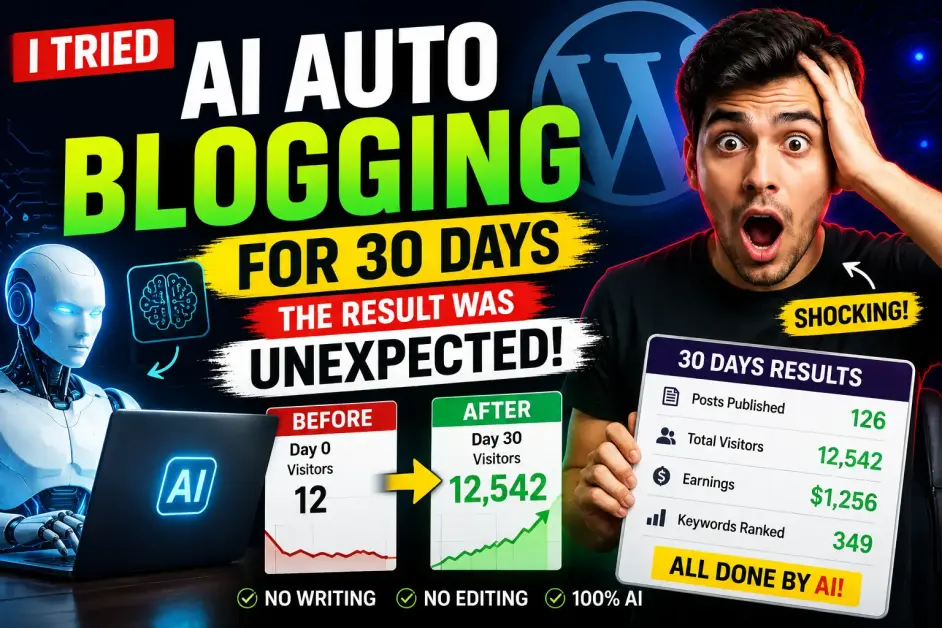
I Tried AI Auto Blogging for 30 Days — What Actually Happened Behind the Traffic Screenshots
There’s AI Auto Blogging Experiment a certain kind of screenshot that has quietly taken over internet marketing circles over the last year.
A dashboard with a sudden traffic spike.
A fresh WordPress site publishing 300 articles in a week.
An earnings graph with just enough blur to look believable.
And somewhere underneath it all, a familiar promise:
"AI blogging changes everything."
At first glance, it sounds plausible. Tools like OpenAI ChatGPT, Anthropic Claude, and dozens of WordPress automation plugins genuinely have changed how online publishing works. A single person can now produce the volume that once required a small editorial team.
But volume and value have never been the same thing.
So I decided to test the idea properly. Not as a Twitter thread. Not as a “make money online” fantasy. A real publishing experiment.
For 30 days, I ran an AI-assisted auto blogging workflow on a fresh niche website using WordPress, AI writing tools, automated keyword clustering, and scheduled publishing. The goal wasn’t just traffic. I wanted to understand whether modern AI blogging could create something sustainable — something that didn’t immediately collapse under the weight of its own automation.
The result was stranger than I expected.
Not catastrophic.
Not magical.
Just deeply revealing about where the internet is heading.
The Setup: What “AI Auto Blogging” Actually Means in 2026
A lot of people imagine AI blogging as pressing a button and watching money appear.
The reality is far messier.
Most modern AI blogging systems combine several layers:
| Workflow Layer | Purpose |
|---|---|
| Keyword Discovery | Finding low-competition search opportunities |
| AI Draft Generation | Creating first-pass articles using LLMs |
| Programmatic Publishing | Uploading and formatting content automatically |
| SEO Optimization | Adding metadata, headings, schema, and internal links |
| Index Monitoring | Tracking whether Google actually accepts the pages |
| Content Revision | Improving weak pages after publication |
The people succeeding with AI content right now are rarely “fully automating” everything. Most are quietly building hybrid systems — AI for speed, humans for judgment.
That distinction matters more than most tutorials admit.
For this experiment, I intentionally avoided extreme automation. No scraping Reddit threads into articles. No spinning existing posts. No publishing 1,000 pages overnight.
The site used:
- WordPress
- Rank Math SEO
- AI-generated first drafts
- Human editing for structure and accuracy
- Manual topical planning
- Internal linking automation
- Basic informational content monetization strategy
The niche itself was moderately competitive: technology tutorials and digital productivity topics.
Not easy. Not impossible.
Exactly the kind of niche where most AI bloggers either burn out or disappear quietly.
Week One: The Seductive Phase
The first week felt almost unfair.
Publishing speed became absurd.
Articles that would normally take three or four hours suddenly existed in twenty minutes. Topic ideation accelerated. Outline generation became frictionless. Even tedious formatting tasks disappeared into automation.
There’s a psychological effect that happens when AI removes creative resistance. You stop hesitating.
That sounds productive. Sometimes it is.
But something subtle starts happening too: you begin mistaking output for progress.
By Day 5, the site already had more than 70 published posts.
And honestly? Some of them looked good.
Get Extra 20% OFF
Launch your website today with ultra-fast, secure & premium hosting from Hostinger. Click to claim your deal!
Readable introductions. Reasonably clean formatting. Surprisingly competent summaries. If you skimmed them quickly, many felt indistinguishable from average mid-tier blog content already ranking online.
That realization alone says a lot about the state of the web.
Because the uncomfortable truth is this:
A massive portion of internet content was already shallow before AI arrived.
AI didn’t invent low-quality publishing. It industrialized it.
The First Real Problem: Everything Started Sounding the Same
Around the second week, the illusion cracked.
Not because traffic collapsed.
Because the writing became emotionally empty.
Even after prompt engineering and stylistic adjustments, patterns emerged:
- Similar sentence cadence
- Repetitive transitions
- Over-structured explanations
- Excessive certainty
- Predictable formatting
- Hollow confidence
Readers may not consciously identify AI writing every time, but they often feel something artificial underneath it.
A strange smoothness.
The internet is quietly developing a new literacy around this. Users can sense when content lacks lived experience — even if the grammar is perfect.
That became obvious when comparing engagement metrics.
Some AI-assisted posts performed surprisingly well in search impressions but poorly in time-on-page. Others ranked briefly, then vanished after Google reevaluated them.
This is where modern SEO conversations get oversimplified.
Google does not appear to “hate AI content” in any simplistic sense. What it increasingly punishes is interchangeable content — pages that exist only because a keyword existed.
That distinction explains why some AI-heavy sites still thrive while others disappear after algorithm updates.
What Surprised Me Most: Google Indexed Less Than Expected
This was the part most YouTube tutorials conveniently skip.
Publishing content is easy.
Getting Google to care is harder.
Out of the first 100+ posts, only a portion indexed quickly. Several pages sat in “Crawled — currently not indexed” status inside Google Search Console for days.
A few never indexed at all.
And the pattern became obvious after deeper analysis:
The pages with stronger original framing, better internal linking, and clearer topical relevance performed better.
Thin AI-generated articles — even well-written ones — increasingly struggled to justify their existence.
Google’s systems appear far more focused on information gain now than many SEO creators admit publicly.
In simple terms:
If your article says the same thing as 500 others, AI merely helps you lose faster at scale.
The Hidden Cost Nobody Talks About
The strangest part of the experiment wasn’t technical.
Get Extra 20% OFF
Launch your website today with ultra-fast, secure & premium hosting from Hostinger. Click to claim your deal!
It was psychological.
AI blogging changes your relationship with publishing itself.
When content becomes effortless to produce, it also becomes easier to stop respecting it.
I noticed myself caring less about individual articles. Less curiosity. Less editorial obsession. Less craftsmanship.
That erosion matters.
Because the internet’s best publications still operate on strong points of view. Whether it’s The Verge, Wired, or independent niche blogs with loyal audiences, memorable content usually carries traces of human perspective.
AI can replicate structure surprisingly well.
It still struggles with genuine intellectual tension.
And readers remember tension.
They remember:
- uncertainty,
- contradiction,
- field experience,
- mistakes,
- nuanced opinions,
- editorial voice.
Most AI auto blogs flatten those things into generic competence.
Competence alone rarely builds loyalty.
The Economics Actually Are Interesting
Now for the part many people really care about.
Did the site make money?
A little.
Traffic began arriving around the third week. Long-tail informational queries started indexing. A few affiliate clicks appeared. Ad impressions slowly increased.
Nothing dramatic.
But enough to reveal something important:
AI dramatically lowers the cost of experimentation.
That changes the economics of publishing more than the writing itself.
A solo creator can now test:
- multiple niches,
- topical clusters,
- search intent variations,
- content angles,
- affiliate funnels,
- micro-sites,
without enormous upfront labor.
That’s genuinely powerful.
The winners in the next era of blogging probably won’t be people producing the most AI content. They’ll be the people running the smartest editorial systems around AI.
That’s a different skill set entirely.
Where AI Blogging Actually Works
After 30 days, certain use cases clearly stood out.
AI performed best when handling:
Structured Informational Content
Tutorials, definitions, setup guides, and basic explainers scaled efficiently.
Get Extra 20% OFF
Launch your website today with ultra-fast, secure & premium hosting from Hostinger. Click to claim your deal!
Topical Coverage Expansion
AI helped fill semantic gaps inside existing content clusters.
Draft Acceleration
Starting from a rough draft is faster than staring at a blank page.
Metadata and Optimization
Titles, FAQs, schema ideas, and internal link suggestions improved workflow speed considerably.
Content Refreshing
Updating outdated posts became dramatically easier.
But areas requiring:
- original reporting,
- strong opinions,
- emotional storytelling,
- investigative depth,
- product experience,
- cultural insight,
still benefited heavily from human involvement.
That balance matters more than the internet’s loudest AI evangelists admit.
The Real Divide Emerging Online
The internet is splitting into two very different publishing ecosystems.
One side is becoming algorithmically abundant:
- mass-generated content,
- AI summaries,
- search-first publishing,
- scaled informational pages,
- automated SEO infrastructure.
The other side is becoming more personality-driven:
- newsletters,
- communities,
- creator brands,
- experience-based writing,
- trusted editorial voices.
Ironically, AI may increase the value of authentic human perspective rather than eliminate it.
Because once everyone can generate words instantly, judgment becomes the scarce asset.
Not production.
Judgment.
Pros and Cons of AI Auto Blogging
| Pros | Cons |
|---|---|
| Massively faster publishing workflow | Content quality can become emotionally flat |
| Lower barrier for new bloggers | Indexing issues remain common |
| Helpful for scaling topical authority | Many articles feel interchangeable |
| Strong support for SEO operations | Requires heavy editorial oversight |
| Reduces research and formatting time | Weak strategy gets amplified faster |
So… Would I Keep Using AI for Blogging?
Yes. But not the way I imagined before the experiment.
AI works best as an editorial multiplier, not a replacement for editorial thinking.
That distinction became impossible to ignore by the end of the month.
The highest-performing articles on the site were rarely the most automated ones. They were the pieces where AI handled the scaffolding while human judgment shaped the narrative, structure, examples, and usefulness.
And honestly, that may be the healthiest future for digital publishing.
Not humans versus AI.
Humans directing AI with clearer intent.
Important Suggestions for new bloggers
- Free AI Tools better than Paid Apps for writing blogs
- Why chatgpt blogs content not ranking tips and tricks
The Unexpected Part Wasn’t the Traffic
Going into the experiment, I expected one of two outcomes.
Either:
- AI blogging would completely fail,
- or it would feel like discovering a publishing cheat code.
Neither happened.
What emerged instead was something more nuanced — and honestly more interesting.
AI is removing friction from online publishing at a historic scale. That absolutely changes blogging. But friction was never the only thing separating good content from forgettable content.
The internet already has enough words.
What it lacks is perspective people trust enough to return to.
And after 30 days of watching AI generate article after article with mechanical confidence, that became impossible to ignore.







💬 Comments (0)
🔒 Please login to post a comment.
Login Now