
I Used ChatGPT to Write Blog Posts… Why Didn’t Google Rank Them?
A surprising number of bloggers had the same experience over the last two years.
They opened OpenAI’s ChatGPT, generated ten blog posts in a weekend, published them with confidence, and waited for traffic that never arrived.
No rankings.
No impressions.
Sometimes not even indexing.
And honestly, the confusion makes sense.
The internet is full of screenshots showing AI-written blogs earning thousands of visits through Google Search. Meanwhile, another site using almost the same workflow disappears into page 12 with zero visibility.
So what changed?
The short answer is this:
Google is not punishing AI-written content simply because AI helped create it. The problem is that most AI-assisted articles fail modern search quality standards in ways many beginners don’t notice.
That distinction matters.
Because the issue usually isn’t “AI content.”
The issue is thin, repetitive, low-value publishing disguised as SEO.
And Google has become unusually good at spotting it.
The Biggest Misunderstanding About AI Content and Google
When Google first commented publicly on AI-generated content, many people interpreted it incorrectly.
Publishers assumed:
“If Google allows AI content, then mass-producing articles with ChatGPT should work.”
That was never the actual message.
Google’s ranking systems increasingly evaluate:
- Originality
- Search intent satisfaction
- Topical authority
- Real-world usefulness
- Trust signals
- Experience-based insights
- Content uniqueness
- Site quality consistency
A chatbot can generate words.
That does not automatically create expertise, relevance, or editorial value.
Google’s systems — especially after the Helpful Content updates — became much more aggressive about filtering pages that feel manufactured primarily for search traffic rather than genuine usefulness.
That’s where many AI-heavy blogs quietly collapsed.
AI Content Usually Fails in the Same Predictable Ways
After reviewing hundreds of low-performing AI blogs across niches like affiliate marketing, tech tutorials, finance, and informational publishing, patterns emerge quickly.
Most unsuccessful AI blogs share these characteristics:
1. They Answer the Query Superficially
A beginner asks ChatGPT:
“Write a blog post about best laptops for students.”
The output sounds polished. It has headings. It looks professional.
But underneath the formatting, the article often says very little.
The recommendations are generic.
The comparisons are shallow.
The insights feel recycled.
Google’s systems increasingly reward depth, specificity, and contextual usefulness — especially in competitive niches.
That means surface-level AI summaries struggle badly against genuinely useful content.
2. The Content Lacks Real Experience
This became a major ranking factor after Google expanded its EEAT framework:
- Experience
- Expertise
- Authoritativeness
- Trustworthiness
Many AI articles sound informational without demonstrating actual lived experience.
For example:
A real laptop reviewer might mention:
- Battery degradation after six months
- Thermal throttling during coding workloads
- Keyboard fatigue during long writing sessions
- Real portability issues for students
AI-generated articles often skip these nuanced observations because they statistically predict text rather than actually test products.
Get Extra 20% OFF
Launch your website today with ultra-fast, secure & premium hosting from Hostinger. Click to claim your deal!
Readers notice this.
Google increasingly does too.
3. AI Blogs Often Create Semantic Redundancy
One of the less-discussed SEO problems with mass AI publishing is semantic duplication.
Many ChatGPT-generated articles follow extremely similar structures:
- Definition
- Benefits
- Features
- Conclusion
- FAQ
Across dozens of pages, the site starts sounding internally repetitive.
This weakens topical differentiation.
Modern search engines evaluate more than keywords now. They evaluate semantic uniqueness and information gain.
If your article contributes nothing new compared to the top 20 results already indexed, ranking becomes difficult.
Why Some AI Content Does Rank
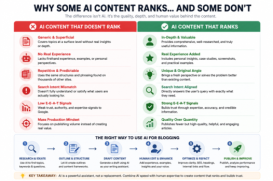
This is where the conversation gets more interesting.
Because AI-assisted publishing absolutely can work.
Many high-performing blogs use AI tools internally. Some editorial teams openly discuss it.
The difference is how they use AI.
The successful publishers typically use AI for:
- Research assistance
- Structural drafting
- Outline generation
- Topic clustering
- Content acceleration
- Rewriting rough sections
- Metadata assistance
- Content gap analysis
But the final article still includes:
- Human editing
- Original examples
- Editorial judgment
- Real opinions
- First-hand observations
- Updated references
- Better formatting
- Clear audience alignment
In other words, AI becomes a productivity layer — not the entire publishing strategy.
That distinction separates scalable publishing from disposable content farms.
Google’s Helpful Content System Changed the Game
Google’s Helpful Content system fundamentally shifted how smaller websites compete.
Older SEO tactics once relied heavily on:
- Keyword density
- Exact-match phrases
- Thin informational targeting
- Mass article publishing
That era has faded significantly.
Today, Google increasingly evaluates whether a site appears genuinely useful overall.
That includes signals like:
- Content originality
- Site-wide quality consistency
- User engagement patterns
- Bounce behavior
- Topical depth
- Trust indicators
- Content freshness
- Expertise signals
This is partly why many AI-heavy affiliate sites lost visibility after aggressive scaling.
The problem wasn’t merely AI usage.
The problem was low editorial quality combined with volume publishing.
Publishing 300 AI Articles Can Actually Hurt Your Site
A mistake many beginners make is assuming:
“More indexed pages = more traffic.”
That logic worked years ago in some niches.
Now, weak content can dilute overall domain quality perception.
If most pages on a site are:
- Thin
- Repetitive
- Outdated
- Low engagement
- Low originality
then even stronger articles may struggle.
Google increasingly evaluates websites holistically rather than page-by-page alone.
That’s why some smaller blogs with only 30 deeply useful articles outperform sites publishing 1,000 AI-generated posts.
The Real Problem: AI Makes Mediocre Content Too Easy
This is the uncomfortable part many tutorials avoid discussing.
Get Extra 20% OFF
Launch your website today with ultra-fast, secure & premium hosting from Hostinger. Click to claim your deal!
Before AI writing tools became mainstream, creating 100 mediocre articles required enormous effort.
Now it takes a weekend.
The internet became flooded with content that looks polished at first glance but offers little informational value.
That changed the competitive environment dramatically.
Search engines had to adapt.
And they did.
Google’s systems are now much better at detecting patterns associated with scaled low-value publishing:
- Generic phrasing
- Predictable structure
- Low information gain
- Weak originality
- Redundant explanations
- Topic saturation
- Thin affiliate intent
Ironically, AI content often fails not because it sounds robotic — but because it sounds too statistically average.
What High-Ranking AI-Assisted Content Usually Does Differently
The strongest AI-assisted publishers treat ChatGPT like a junior assistant, not an autonomous writer.
That workflow matters.
Here’s what successful content creators often do instead:
| Low-Performing AI Blogs | High-Performing AI-Assisted Blogs |
|---|---|
| Publish raw AI output | Heavily edit and restructure content |
| Target broad generic keywords | Target specific user intent |
| No firsthand insight | Add experience-based commentary |
| Mass publishing strategy | Selective high-quality publishing |
| Repetitive structures | Editorially varied content flow |
| Keyword-first writing | User-first writing |
| Thin informational pages | Deep topical authority building |
That second column increasingly aligns with how Google rewards independent publishers today.
Search Intent Is More Important Than Ever
One of the most overlooked SEO mistakes with ChatGPT-generated articles is poor search intent alignment.
AI often produces generalized answers unless prompted carefully.
But modern SEO depends heavily on matching exact user expectations.
For example:
Someone searching:
“Why is my ChatGPT content not ranking on Google?”
is probably looking for:
- Diagnostic explanations
- SEO mistakes
- Real examples
- Recovery strategies
- Google policy interpretation
- Content quality insights
They are not looking for:
- A generic definition of AI content
- Keyword stuffing advice from 2018
- Empty motivational SEO tips
Intent mismatch quietly destroys rankings.
Human Editing Is No Longer Optional
This is the simplest advice most AI bloggers need to hear:
Raw AI output is usually not enough.
Not because AI is useless.
But because search visibility increasingly rewards:
- Perspective
- Specificity
- Information gain
- Credibility
- Experience
- Freshness
- Editorial refinement
Human editing creates differentiation.
That includes adding:
- Case studies
- Contrarian observations
- Screenshots
- Real testing
- Workflow examples
- Industry context
- Updated references
- Nuanced opinions
Without those layers, many AI articles remain interchangeable with thousands of others online.
And interchangeable content rarely ranks well anymore.
Pros and Cons of Using ChatGPT for Blogging
| Pros | Cons |
|---|---|
| Speeds up content production | Can create generic content quickly |
| Helps brainstorm topics | Often lacks firsthand expertise |
| Useful for outlines and drafts | May produce factual inaccuracies |
| Improves workflow efficiency | Creates semantic repetition at scale |
| Helpful for beginners learning structure | Low editorial quality hurts rankings |
| Good for content ideation | Weak intent alignment is common |
What Bloggers Should Do Instead
If your AI-written blog posts are not ranking, the solution usually is not abandoning AI completely.
It’s changing the workflow.
A more sustainable strategy looks like this:
Get Extra 20% OFF
Launch your website today with ultra-fast, secure & premium hosting from Hostinger. Click to claim your deal!
Use AI for Acceleration — Not Replacement
Let AI help with:
- Outlines
- Draft organization
- Research summaries
- Topic ideas
- FAQ generation
- Meta descriptions
- Semantic coverage
But keep human judgment central.
Build Topical Authority Slowly
Instead of publishing 100 random articles:
Build focused clusters.
For example:
If your niche is blogging SEO:
Create genuinely useful content around:
- Internal linking
- Keyword research
- Search intent
- Topical authority
- Content pruning
- EEAT
- Google Search Console
- On-page SEO
- Affiliate SEO mistakes
Topical depth matters more now than scattered keyword chasing.
Add Real Experience
This alone can dramatically improve content quality.
Even small details help:
- “I tested this on a new blog.”
- “After updating 40 AI articles…”
- “Traffic improved after rewriting intros.”
- “Google indexed the rewritten version faster.”
Specificity creates trust.
Generic content rarely does.
The Future of AI Blogging Probably Won’t Look Like Content Farms
The early AI publishing boom created unrealistic expectations.
Many people assumed AI would automate rankings.
Instead, the opposite happened.
Search engines adapted quickly.
What’s emerging now is a more mature model where AI acts as:
- Editorial support
- Workflow acceleration
- Research assistance
- Draft refinement
—not as a replacement for thoughtful publishing.
The sites still winning organic traffic tend to combine:
- Human expertise
- Strong editorial standards
- Search intent awareness
- Technical SEO
- Topical authority
- Useful originality
That combination is much harder to automate.
And that’s probably the point.
FAQ
Does Google penalize AI-generated content?
Google does not automatically penalize AI-generated content. The issue is low-quality, unhelpful, or manipulative content — regardless of whether humans or AI created it.
Can ChatGPT-written articles rank on Google?
Yes. Many AI-assisted articles rank well when they are heavily edited, useful, original, and aligned with search intent.
Why are my AI blog posts not getting indexed?
Common reasons include:
- Thin content
- Low domain authority
- Poor internal linking
- Weak originality
- Technical SEO issues
- Low-quality site signals
Is AI content bad for affiliate marketing?
Not necessarily. But mass-produced affiliate content with little value often struggles after Google’s Helpful Content updates.
Should beginners stop using ChatGPT for blogging?
No. ChatGPT can be extremely useful for ideation, outlining, and workflow efficiency. The key is combining AI assistance with human expertise and editorial quality.
Suggestions for new bloggers
- How to write Blogs through AI
- Beginner’s Guide to Search Intent
- How to find low competition keyword
- Why Thin Content Kills Organic Traffic
- Top seo tools that help for writing blogs
Editorial Professional conclusion about Bloggers
A lot of beginner bloggers expected AI writing tools to simplify SEO.
Instead, AI ended up exposing a deeper truth about modern search:
Google no longer rewards content simply for existing.
It rewards usefulness, originality, clarity, and trust.
That’s why some ChatGPT-assisted blogs thrive while others disappear quietly without traffic.
The winning publishers aren’t the ones generating the most words.
They’re the ones adding the most value.
And right now, value still requires human judgment.







💬 Comments (0)
🔒 Please login to post a comment.
Login Now