
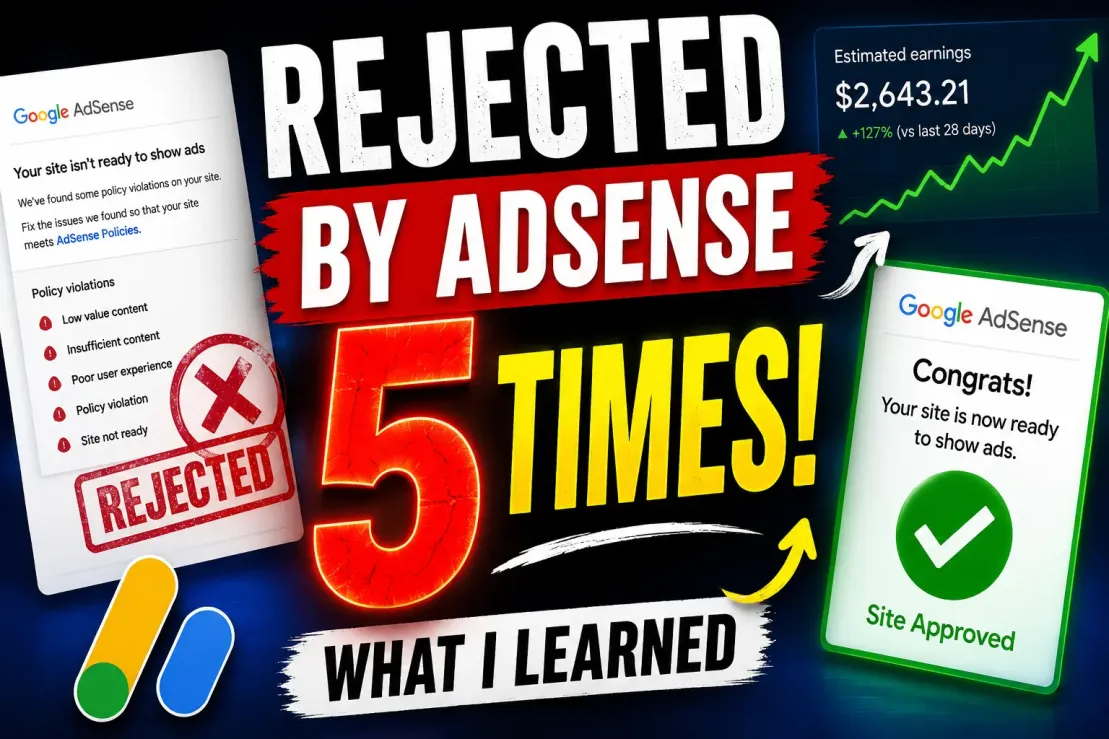
My Blog Got Rejected by AdSense 5 Times: The Hard Lessons That Finally Led to Approval
The Email I Started Dreading
There is a particular kind of disappointment that only website owners understand.
You spend weeks writing articles. You improve page speed. You add privacy policies. You carefully place navigation menus. Then you submit your website to Google AdSense and wait.
A few days later, an email arrives.
Rejected.
You make changes.
Submit again.
Rejected.
Again.
Rejected.
By the fifth rejection, the problem no longer feels technical. It feels personal.
That was my experience.
What surprised me wasn't the rejection itself. Google rejects thousands of websites every day. The surprising part was discovering that most of the advice circulating online was either outdated, incomplete, or focused on superficial fixes rather than the deeper signals AdSense actually evaluates.
This isn't a story about a magical trick that suddenly unlocked approval. It's about understanding how Google evaluates modern websites and why many otherwise legitimate blogs struggle to pass the review process.
For bloggers, affiliate marketers, niche website builders, and content creators, these lessons may save months of frustration.
Understanding What AdSense Is Actually Reviewing
Many publishers assume AdSense reviews websites the same way a human editor would.
In reality, the review process appears to combine policy checks, quality assessments, trust signals, user experience factors, and content evaluation.
Google is not simply asking:
"Can this website display ads?"
The bigger question is:
"Should advertisers trust this website with their budget?"
That distinction changes everything.
A site can be technically functional and still fail because it doesn't demonstrate enough authority, trust, usefulness, or originality.
The moment I stopped optimizing for approval and started optimizing for quality, things began to change.
The First Mistake: Publishing Too Little Content
One of the biggest myths in blogging communities is that there is a specific number of articles required for AdSense approval.
Some claim 10 articles.
Others say 20.
Some insist 50.
The reality is more nuanced.
Get Extra 20% OFF
Launch your website today with ultra-fast, secure & premium hosting from Hostinger. Click to claim your deal!
My first rejected website had around a dozen articles. While the number itself wasn't necessarily the issue, the overall depth of coverage was weak.
The content felt incomplete.
The website lacked topical authority.
Google could not easily determine whether the site was genuinely valuable or simply assembled to obtain advertising revenue.
Instead of focusing on article count, I began focusing on content ecosystems.
Before Approval
| Content Element | Status |
|---|---|
| Standalone Articles | Yes |
| Topic Clusters | No |
| Comprehensive Guides | No |
| Supporting Content | Minimal |
After Approval
| Content Element | Status |
|---|---|
| Standalone Articles | Yes |
| Topic Clusters | Yes |
| Comprehensive Guides | Yes |
| Supporting Content | Strong |
The difference was substantial.
The website began looking like a resource rather than a monetization project.
The Second Mistake: Thin Content Hidden Behind Big Word Counts
Many bloggers confuse length with quality.
I certainly did.
Several articles exceeded 2,000 words. On paper, they looked substantial.
In practice, they contained repetitive explanations, generic observations, and information that could have been delivered more effectively in half the space.
Google's quality systems have evolved significantly.
A long article is not inherently valuable.
A useful article is.
The content that eventually helped secure approval shared three characteristics:
- It answered specific user questions.
- It demonstrated expertise.
- It provided unique value beyond basic search results.
This shift forced me to become more of an editor and less of a content producer.
The Third Mistake: Treating Trust Pages as an Afterthought
This sounds boring.
Unfortunately, it matters.
My early websites had privacy policies because everyone said they were necessary.
What they lacked was a broader trust framework.
Eventually I added:
- About Us page
- Contact page
- Editorial disclosure
- Privacy policy
- Terms and conditions
- Content update information
None of these pages generate traffic.
None of them rank for competitive keywords.
Yet collectively they communicate legitimacy.
For Google, trust is often inferred through small signals rather than dramatic indicators.
The User Experience Problem I Completely Missed
Most AdSense discussions focus on content.
Far fewer talk about usability.
That is a mistake.
Get Extra 20% OFF
Launch your website today with ultra-fast, secure & premium hosting from Hostinger. Click to claim your deal!
When I reviewed my rejected website objectively, several problems became obvious:
- Confusing navigation
- Inconsistent design
- Excessive whitespace
- Poor mobile experience
- Weak internal linking
Nothing was catastrophically broken.
But the website felt unfinished.
A visitor landing on the site could access information, but the experience wasn't particularly smooth.
Modern publishing is no longer just about content quality.
It's about content accessibility.
Why Mobile Experience Matters More Than Ever
A significant percentage of web traffic now originates from smartphones.
Google understands this.
Many website owners still evaluate their sites primarily from desktop screens.
I did too.
When I began auditing pages on mobile devices, problems became painfully obvious:
- Text spacing issues
- Slow-loading elements
- Large images
- Awkward menus
- Poor reading flow
Improving mobile usability wasn't the sole reason for approval, but it was undoubtedly part of the broader quality improvement process.
The Hidden Problem: Looking Like an AdSense Site
This may sound strange.
Many websites unintentionally look built exclusively for advertising.
They contain:
- Generic content
- Minimal branding
- Weak expertise signals
- Limited audience focus
- Aggressive monetization intent
Google's systems appear increasingly capable of distinguishing between websites created primarily for users and websites created primarily for revenue extraction.
The difference isn't always visible in a single page.
It's visible across the entire site experience.
The website that finally received approval felt less like a project and more like a publication.
That distinction matters.
Originality Became My Competitive Advantage
One observation became increasingly clear throughout the process.
Many rejected websites looked almost identical.
They covered the same topics.
Used similar headings.
Repeated identical advice.
Offered no unique perspective.
The internet already contains millions of articles.
Google doesn't need more duplicates.
Get Extra 20% OFF
Launch your website today with ultra-fast, secure & premium hosting from Hostinger. Click to claim your deal!
What it values is original contribution.
That doesn't require groundbreaking research.
Sometimes originality simply means:
- Personal experience
- First-hand testing
- Unique analysis
- Better explanations
- Fresh examples
- Stronger context
The article you're reading now exists because of that realization.
Five rejections created more useful insight than a quick approval ever would have.
What Finally Changed Before Approval
There wasn't a single breakthrough moment.
Instead, several improvements accumulated over time.
| Area | Change Made |
|---|---|
| Content Quality | Expanded topical depth |
| User Experience | Improved navigation and structure |
| Trust Signals | Added complete policy pages |
| Mobile Optimization | Reduced friction and clutter |
| Originality | Added personal insights and expertise |
| Site Structure | Strengthened internal linking |
The approval email eventually arrived.
Ironically, by that stage, I had become less focused on AdSense itself.
The website was simply better.
AdSense approval became a byproduct of that improvement.
Pros and Cons of Repeated AdSense Rejections
Advantages
- Forces deeper website audits
- Encourages stronger content quality
- Improves long-term publishing standards
- Helps identify structural weaknesses
- Builds a more sustainable website
Disadvantages
- Delays monetization
- Creates uncertainty
- Can discourage new publishers
- Leads many creators to chase bad advice
- May cause unnecessary redesigns
What New Bloggers Should Focus On Instead of Approval Tricks
The internet is full of shortcuts.
Most don't work.
Instead of searching for secret approval formulas, focus on fundamentals:
Build for Readers First
Websites designed around user needs tend to outperform websites designed around monetization.
Create Topical Authority
Cover subjects comprehensively rather than publishing random articles.
Improve Trust Signals
Transparency matters.
Optimize Navigation
Help users find information quickly.
Publish Original Insights
Even small personal observations can differentiate content.
Important Suggestions for users
External Authority Mentions
This topic intersects with guidance and quality standards discussed by:
These resources provide official guidance on website quality, monetization policies, user experience, and publisher compliance.
Editorial Closing for Blog authority users
Looking back, the five rejections were frustrating, but they exposed a reality that many website owners eventually discover.
AdSense approval is rarely about a missing plugin, a hidden setting, or a secret checklist.
AdSense Rejected 5 Times why it happens
It is often a reflection of overall website quality.
The websites that survive algorithm updates, attract loyal audiences, earn natural backlinks, and generate sustainable revenue usually share the same foundation: they were built to solve problems for readers, not merely to display advertisements.
The approval email eventually arrived.
What mattered more was what happened before it.
The process transformed a website that wanted ad revenue into a website that deserved it.





💬 Comments (0)
🔒 Please login to post a comment.
Login Now