
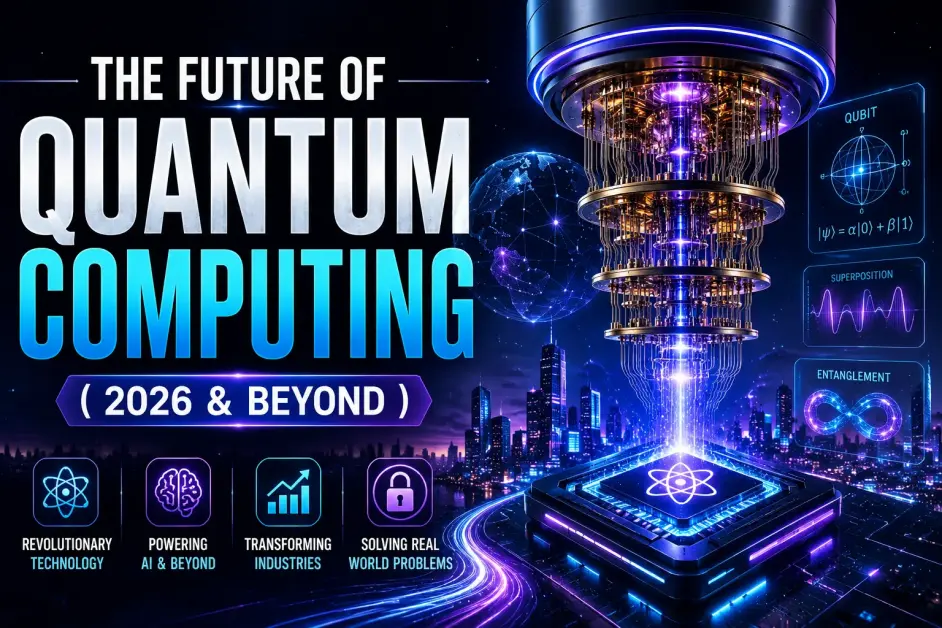
The Future of Quantum Computing: Beyond the Hype and Into the Logical Qubit Era
The conversation around quantum computing has historically been dominated by theoretical promises and astronomical physical qubit counts. We spent the last decade trapped in the Noisy Intermediate-Scale Quantum (NISQ) era, watching hardware providers race to pack more unstable qubits onto a single chip. But walking the floors of industry conferences in mid-2026, the narrative has fundamentally fractured. The obsession with raw physical qubits is dead.
We have officially entered the era of the verified logical qubit.
For enterprise architects, research scientists, and technology strategists, the future of quantum computing is no longer a distant, abstract horizon. It is a highly competitive, rapidly accelerating engineering discipline happening right now. The current inflection point wasn't reached through magic, but through brutal, unglamorous advances in quantum error correction (QEC) and cross-modality hardware scaling. With processors proving exponential error suppression and alternative hardware stabilizing unprecedented numbers of logical qubits, the timeline for utility-scale quantum systems has violently compressed.
Let's examine the actual architecture of this transition, stripping away the marketing veneer to look at where quantum computing stands today, and how the convergence of classical supercomputing and quantum processing is rewriting enterprise roadmaps.
The Death of the NISQ Era and the Rise of Logical Qubits
To understand where quantum is going, you have to understand the fundamental fragility of quantum information. Physical qubits—whether they are superconducting transmons, trapped ions, or neutral atoms—are inherently unstable. They continuously interact with their environment, leading to decoherence and computational collapse.
For years, the industry attempted to mitigate this by simply building larger, albeit noisy, processors. The math, however, eventually caught up with us. To execute an algorithm of any commercial value—such as simulating complex molecular dynamics for drug discovery or factoring large primes—you need gate fidelities that physically cannot exist without intervention. If a circuit requires $10^{12}$ operations, a physical error rate of $10^{-3}$ means your output is indistinguishable from random noise long before the calculation finishes.
This is why recent months have been so pivotal: quantum error correction transitioned from theoretical certainty to experimental reality. QEC encodes a single logical qubit into a massive entangled state of multiple physical qubits. By continuously measuring parity through syndrome extraction, the system can detect and correct errors without directly measuring—and thus destroying—the delicate quantum state, mathematically described as $|\psi\rangle = \alpha|0\rangle + \beta|1\rangle$.
The Threshold Theorem's Role
The underlying principle driving this shift is the threshold theorem. It dictates that if the physical error rate of your hardware falls below a certain mathematical threshold, adding more physical qubits will suppress logical errors exponentially. The new headline benchmark across the industry is the code distance $d$. In topological systems like surface codes, the maximum number of correctable errors $t$ scales directly with the distance, governed by the relation $t = \lfloor \frac{d-1}{2} \rfloor$.
We are finally seeing hardware where increasing the physical qubit overhead actually drives the logical error rate down, rather than introducing more noise into the system. Validating this theorem in silicon has shifted the entire industry's focus from "building bigger chips" to "building better error correction."
Modality Wars: Superconducting vs. Neutral Atom vs. Trapped Ion
The future of quantum computing isn't a monolith. It is a fragmented hardware ecosystem where radically different physical modalities are battling for data center supremacy. Each approach carries distinct thermodynamic, physical, and economic trade-offs.
Superconducting Circuits: The Brute Force Path
IBM and Google have bet heavily on superconducting circuits, leveraging existing semiconductor fabrication infrastructure. These systems operate at temperatures colder than deep space, utilizing Josephson junctions to manage quantum states. IBM’s updated roadmap centers heavily on its modular architecture. We are moving away from single massive chips toward multi-chip modules connected via specialized quantum communication links. This is the foundation of what the industry calls "quantum-centric supercomputing." The immediate goal isn't just qubit volume, but modularity. By linking chips, hardware providers can bypass the severe physical limits and cooling constraints of a single dilution refrigerator.
Neutral Atoms: The Dark Horse
While superconducting systems get the most press, neutral atom technology has quietly become the most aggressive challenger in the landscape. Companies like QuEra and Atom Computing use precisely focused lasers (optical tweezers) to trap individual atoms in highly configurable 2D and 3D grids. Because they use naturally identical atoms rather than manufactured circuits, they completely sidestep the microscopic manufacturing defects that plague superconducting qubits. More importantly, neutral atom systems have recently demonstrated massive breakthroughs in logical qubit generation. When researchers published peer-reviewed demonstrations of high-volume logical qubits with below-threshold error suppression, it forced a complete recalibration of enterprise adoption timelines.
Trapped Ions: The Fidelity Kings
Quantinuum and IonQ continue to lead in raw fidelity metrics. Trapped ion systems suspend charged atomic particles in electromagnetic fields. They feature extremely long coherence times and all-to-all connectivity—meaning any qubit can easily entangle with any other on the trap, drastically reducing the software overhead required to run complex algorithms. Recent demonstrations proving dozens of logical qubits on trapped ion hardware show that what this modality lacks in raw gate speed, it makes up for in unparalleled algorithmic depth and accuracy.
Why Quantum Computing Matters
The significance of quantum computing isn't about making everyday computing faster.
Its real value lies in solving problems that are currently impractical—even for the world's most powerful supercomputers.
Potential applications include:
- Drug discovery
- Climate modeling
- Financial forecasting
- Logistics optimization
- Materials science
- Cryptography
- Artificial intelligence
- Energy research
- Aerospace engineering
In many of these fields, the complexity of calculations grows exponentially as variables increase.
Quantum computing offers a fundamentally different approach to tackling these computational bottlenecks.
The Current State of Quantum Computing
The industry remains in what researchers often describe as the NISQ era (Noisy Intermediate-Scale Quantum).
Current systems contain relatively limited numbers of qubits and are prone to errors.
Leading players include:
Get Extra 20% OFF
Launch your website today with ultra-fast, secure & premium hosting from Hostinger. Click to claim your deal!
- IBM Quantum
- Google Quantum AI
- Microsoft Azure Quantum
- Amazon Braket
- IonQ
- Rigetti Computing
- D-Wave Systems
While significant technical milestones have been achieved, practical large-scale quantum computing remains under development.
The gap between laboratory success and commercial deployment is still substantial.
ALSO READ: Best wordpress plugins for bloggers
The Technologies Driving the Future of Quantum Computing
1. Error Correction Breakthroughs
Error correction is arguably the most important challenge facing quantum computing.
Unlike classical computers, quantum systems are highly susceptible to noise and interference.
Researchers are developing sophisticated quantum error correction methods capable of maintaining stable computations over longer periods.
Many experts believe widespread commercial adoption will depend more on error correction progress than on raw qubit counts.
2. Scalable Quantum Hardware
Building larger quantum systems is not as simple as adding more processing units.
Engineers must ensure:
- Stability
- Reliability
- Cooling efficiency
- Error reduction
- Interconnectivity
Several competing hardware approaches are emerging:
| Quantum Technology | Key Advantage | Main Challenge |
|---|---|---|
| Superconducting Qubits | Fast processing | Error sensitivity |
| Trapped Ions | High accuracy | Slower operations |
| Photonic Quantum Systems | Room-temperature potential | Scaling complexity |
| Neutral Atom Systems | Flexible architectures | Early-stage development |
The industry has not yet settled on a single dominant architecture.
3. Quantum Cloud Computing
Most organizations will never own quantum hardware directly.
Instead, access will likely come through cloud platforms.
This model mirrors how artificial intelligence infrastructure evolved.
Businesses can already experiment with quantum systems through cloud services provided by IBM, Microsoft, Amazon, and other providers.
Quantum-as-a-Service (QaaS) is expected to become one of the industry's fastest-growing segments.
Industries Most Likely to Benefit
Not every sector will experience quantum disruption at the same pace.
Some industries stand to gain much earlier than others.
Pharmaceutical Research
Drug discovery involves analyzing vast molecular interactions.
Quantum computers could simulate molecular behavior far more efficiently than conventional systems.
This may dramatically reduce:
Get Extra 20% OFF
Launch your website today with ultra-fast, secure & premium hosting from Hostinger. Click to claim your deal!
- Research timelines
- Development costs
- Experimental failures
For pharmaceutical companies, even modest improvements could save billions.
Financial Services
Banks and investment firms constantly solve optimization problems involving risk, portfolio allocation, and market simulations.
Quantum algorithms could potentially improve:
- Risk analysis
- Fraud detection
- Asset pricing
- Market forecasting
Major financial institutions are already funding quantum research programs.
Logistics and Supply Chains
Modern supply chains involve millions of variables.
Quantum optimization could help organizations:
- Reduce fuel consumption
- Improve routing efficiency
- Minimize delivery delays
- Optimize inventory management
This application area is attracting interest from transportation, manufacturing, and e-commerce companies.
Energy and Climate Research
Energy companies face complex challenges involving:
- Battery chemistry
- Renewable energy systems
- Carbon capture
- Grid optimization
Quantum simulation could accelerate breakthroughs in these areas.
Climate scientists also see potential for improved environmental modeling.
Quantum Computing and Artificial Intelligence
One of the most discussed future developments involves the convergence of quantum computing and AI.
Current AI systems require enormous computational resources.
Quantum-enhanced machine learning may eventually help:
- Process large datasets
- Improve optimization
- Accelerate training
- Enhance pattern recognition
However, this remains an emerging field.
Many researchers caution that expectations around quantum AI currently exceed available evidence.
Still, the intersection of AI and quantum computing represents one of the most closely watched research areas in modern technology.
ALSO READ: Worlds fastest tech growing companies right now
The Cybersecurity Challenge Nobody Can Ignore
Perhaps the most immediate concern surrounding quantum computing involves cybersecurity.
Many current encryption methods rely on mathematical problems that are difficult for classical computers to solve.
Powerful future quantum computers could potentially break some widely used cryptographic systems.
This has triggered global efforts to develop post-quantum cryptography.
Get Extra 20% OFF
Launch your website today with ultra-fast, secure & premium hosting from Hostinger. Click to claim your deal!
Organizations including the National Institute of Standards and Technology are actively working on quantum-resistant encryption standards.
Businesses handling sensitive data should already be assessing long-term quantum security risks.
The transition to quantum-safe encryption may become one of the largest cybersecurity migrations in history.
Challenges That Could Slow Progress
Despite the optimism, several obstacles remain.
Technical Complexity
Quantum systems require highly specialized environments.
Many operate at temperatures colder than outer space.
Maintaining these conditions is expensive and technically demanding.
Talent Shortages
Quantum computing combines expertise from:
- Physics
- Mathematics
- Computer science
- Engineering
- Materials science
The global talent pool remains limited.
Universities are rapidly expanding quantum education programs, but demand still exceeds supply.
High Costs
Developing quantum hardware requires significant investment.
Only well-funded corporations, governments, and specialized startups currently possess the resources necessary to compete at scale.
Commercial Viability
A critical question remains unanswered:
Can quantum computers consistently deliver measurable business value that justifies their costs?
The next decade will likely provide clearer answers.
Future of Quantum Computing: Predictions for the Next 10–20 Years
While forecasting emerging technologies is always risky, several trends appear increasingly likely.
Short-Term (2026–2030)
- Improved quantum hardware
- Better error correction
- Growth of quantum cloud services
- Increased enterprise experimentation
- Expansion of post-quantum cybersecurity initiatives
Mid-Term (2030–2035)
- Commercial quantum advantage in specialized industries
- Broader enterprise adoption
- More sophisticated quantum software ecosystems
- Integration with AI and high-performance computing platforms
Long-Term (2035 and Beyond)
- Fault-tolerant quantum systems
- Industry-specific quantum applications
- New scientific discoveries enabled by advanced simulations
- Potential restructuring of certain cybersecurity frameworks
The future is unlikely to arrive through a single breakthrough moment. Instead, progress will probably emerge through hundreds of incremental advances.
Advantages and Limitations of Quantum Computing
| Advantages | Limitations |
|---|---|
| Solves highly complex optimization problems | Extremely expensive hardware |
| Potential scientific breakthroughs | High error rates |
| Accelerated molecular simulations | Difficult scaling challenges |
| Enhanced computational capabilities | Specialized expertise required |
| New possibilities in AI and materials science | Limited real-world applications today |
The Reality of the Next Five Years
The transition from the noisy, experimental era to the fault-tolerant era is no longer a purely academic exercise. The foundational physics problems have largely been proven out, and the discipline has firmly transitioned into an intense engineering challenge. We are now dealing with the practical realities of cabling density, cryogenic cooling limits, laser precision, and classical control systems.
For organizations monitoring the future of quantum computing, the waiting period is over. The hardware milestones set for the end of the decade are mapped out with incredible specificity, backed by the largest technology entities on earth. Technology leaders must begin auditing their cryptographic infrastructure and identifying computational bottlenecks within their own workflows that map directly to quantum capabilities. The barrier to entry for quantum development—thanks to cloud-based QPUs and abstracted software libraries—has never been lower, but the cost of ignoring this shift will soon be unrecoverable.







💬 Comments (0)
🔒 Please login to post a comment.
Login Now