
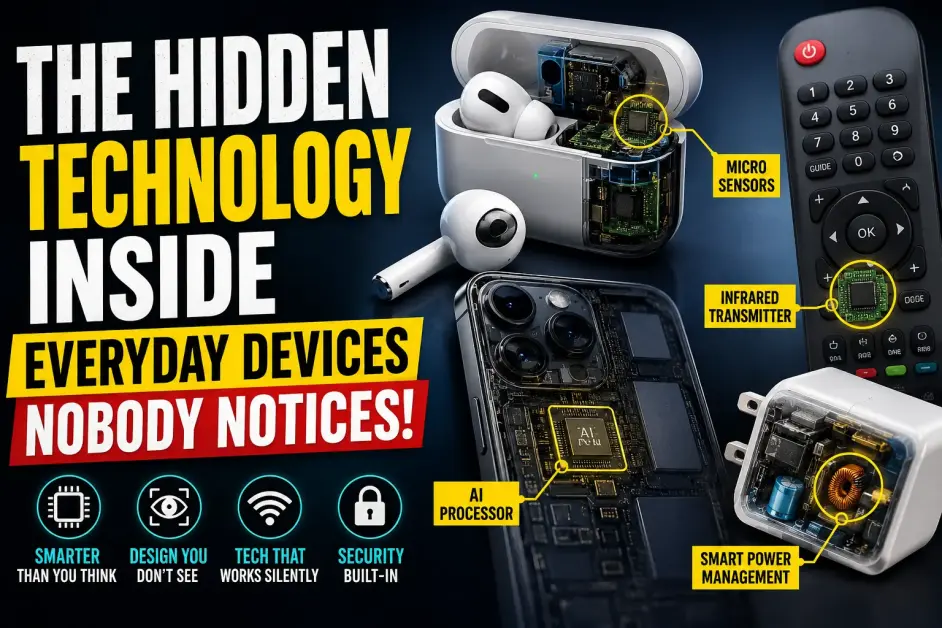
The Hidden Technology Inside Everyday Devices Nobody Notices
There’s a strange irony in modern consumer technology: the smarter devices become, the less visible their intelligence feels.
A decade ago, gadgets advertised their complexity. Transparent gaming consoles, exposed circuitry in concept phones, blinking LEDs everywhere — technology wanted to be seen. Today, the most advanced engineering often disappears into silence. Your phone unlocks before you consciously look at it. Your earbuds adjust noise cancellation mid-conversation. Your Wi-Fi router quietly prioritizes video calls over gaming traffic without asking permission.
Most people never notice any of it.
And that’s partly the point.
The modern electronics industry has shifted from visible innovation to invisible computation — systems designed to fade into the background while continuously sensing, adapting, optimizing, and predicting human behavior in real time. Hidden technology is no longer reserved for laboratories or military systems. It now lives inside charging adapters, televisions, fitness bands, smart speakers, kitchen appliances, and even ordinary remote controls.
The interesting part isn’t just what these devices can do. It’s how much they’re doing without users realizing it.
Why Modern Devices Feel “Smarter” Without Looking Different
A smartphone from 2026 doesn’t look radically different from one released five years ago. The rectangular slab remains. The glass remains. The cameras get slightly larger.
Yet internally, the leap is enormous.
Much of that advancement comes from technologies consumers rarely see marketed directly:
- Neural processing units (NPUs)
- MEMS sensors
- On-device AI accelerators
- Infrared mapping systems
- Power optimization chips
- Ultra-wideband radios
- Tiny environmental sensors
- Edge computing architectures
Companies like Apple, Samsung, Qualcomm, and Google increasingly compete on computational intelligence rather than visible hardware alone.
That shift has changed the relationship between users and devices. People no longer buy phones purely for hardware specifications. They buy ecosystems that quietly automate life.
And automation depends on hidden systems.
The Tiny Sensors Quietly Mapping Your Life
Most users understand cameras and microphones. Fewer realize how many secondary sensors operate continuously inside modern devices.
A typical flagship smartphone now contains more than a dozen sensor systems working simultaneously.
| Technology | What It Does | Where It’s Commonly Used |
|---|---|---|
| Accelerometer | Detects movement and orientation | Phones, smartwatches, gaming controllers |
| Gyroscope | Tracks rotational motion | VR devices, smartphones, drones |
| Ambient Light Sensor | Adjusts display brightness | Laptops, TVs, phones |
| LiDAR Sensor | Measures spatial depth | AR devices, smartphones |
| Barometer | Measures air pressure and elevation | Fitness devices, phones |
| Proximity Sensor | Detects nearby objects | Phone call systems, smart displays |
Individually, these sensors seem minor. Collectively, they create behavioral awareness.
Your smartwatch can infer stress levels from heart-rate variability. Your earbuds detect when you begin speaking. Some modern televisions monitor ambient lighting to alter picture temperature automatically.
These are not futuristic concepts anymore. They are standard consumer features hidden behind ordinary interfaces.
What’s changed is scale.
The semiconductor industry has become extraordinarily efficient at shrinking complex sensing hardware into microscopic packages. MEMS — micro-electromechanical systems — are now so compact that devices can contain multiple motion and environmental sensors without affecting size or battery life.
Get Extra 20% OFF
Launch your website today with ultra-fast, secure & premium hosting from Hostinger. Click to claim your deal!
The average user never thinks about this engineering because the systems are designed to disappear.
Smartphones Are Quietly Becoming AI Computers
For years, AI felt cloud-dependent. Virtual assistants needed internet access. Image processing happened remotely. Voice recognition required massive server farms.
That architecture is changing rapidly.
Modern mobile processors from MediaTek, Qualcomm, and Apple now include dedicated AI hardware capable of running machine learning tasks locally.
This matters more than most consumers realize.
On-device AI enables:
- Real-time photo enhancement
- Live translation
- Background noise isolation
- Predictive battery optimization
- Voice recognition without internet
- Smart text suggestions
- Advanced spam detection
- Contextual app behavior
What appears “instant” to users is often the result of specialized neural processors performing billions of operations invisibly.
There’s also a privacy dimension here.
As regulatory pressure grows in regions like the European Union, companies increasingly market local AI processing as a privacy advantage. Sensitive computations can remain on-device instead of being transmitted to remote servers.
This is one reason “AI phones” have become a marketing category. Not because phones suddenly gained intelligence overnight, but because the underlying computational architecture changed quietly over several hardware generations.
The Technology Inside Chargers Is More Advanced Than Old Computers
The humble charging brick might be one of the least appreciated engineering achievements in consumer electronics.
Fast chargers today contain:
- Intelligent voltage regulation
- Heat monitoring systems
- Dynamic power negotiation
- Overcurrent protection
- Gallium Nitride (GaN) semiconductors
- Power conversion controllers
A modern GaN charger from brands like Anker or UGREEN can deliver dramatically higher efficiency while remaining physically smaller than older silicon-based adapters.
That’s not cosmetic innovation. It’s materials science.
Gallium Nitride allows power components to switch faster and waste less energy as heat. The result is smaller chargers capable of powering laptops, tablets, smartphones, and gaming handhelds simultaneously.
Ten years ago, this level of power density would have seemed impractical in consumer accessories.
Now it sits forgotten behind couches and office desks.
Your Wi-Fi Router Is Probably Making Decisions You Never Approved
Most people think of routers as passive internet boxes. In reality, modern networking hardware behaves more like traffic-management infrastructure.
High-end routers from companies like ASUS, TP-Link, and Netgear constantly analyze:
Get Extra 20% OFF
Launch your website today with ultra-fast, secure & premium hosting from Hostinger. Click to claim your deal!
- Device priority
- Signal congestion
- Packet latency
- Streaming quality
- Gaming traffic
- Smart home activity
- Mesh node performance
Many systems now use AI-assisted optimization to distribute bandwidth dynamically.
If your video call remains stable while someone else streams 4K video nearby, hidden traffic prioritization systems are likely involved.
Wi-Fi 7 and mesh networking have accelerated this shift further. Routers increasingly behave like adaptive ecosystems rather than static access points.
The irony is that the better these systems work, the less users notice them.
Invisible reliability is still invisible.
Smart Homes Are Quietly Becoming Behavioral Prediction Systems
The phrase “smart home” still sounds slightly futuristic, but most homes already contain fragmented versions of it.
Smart speakers, TVs, thermostats, cameras, lighting systems, robotic vacuums, and connected appliances continuously gather environmental and behavioral information.
Not always maliciously. Often functionally.
A thermostat learns temperature preferences. A speaker recognizes voice patterns. A robot vacuum maps room layouts. Smart lighting adapts to daily routines.
But collectively, these systems form behavioral profiles.
That’s where the conversation becomes more complicated.
Companies like Amazon and Google position smart ecosystems around convenience. Critics, meanwhile, raise concerns about data collection, cloud dependency, and long-term privacy implications.
Both perspectives contain truth.
Consumers increasingly trade passive data access for automation benefits. The transaction often feels acceptable because the convenience is immediate while the risks remain abstract.
Most users don’t think deeply about the sensors embedded inside thermostats or smart displays until something goes wrong — a security breach, an outage, or a controversial policy change.
That tension now defines much of modern consumer technology.
Hidden Technology Is Changing Human Behavior
The deeper story here isn’t just hardware.
It’s behavioral adaptation.
People increasingly expect invisible automation:
Get Extra 20% OFF
Launch your website today with ultra-fast, secure & premium hosting from Hostinger. Click to claim your deal!
- Phones that predict intent
- Cars that monitor attention
- Cameras that stabilize automatically
- Devices that self-optimize silently
- Systems that anticipate routine
This expectation changes user psychology.
Friction begins to feel abnormal.
Even small delays — buffering, lag, brightness mismatches, weak Bluetooth pairing — now feel disproportionately irritating because hidden technology has conditioned users to expect seamlessness.
In many ways, the consumer tech industry succeeded too well.
Users rarely appreciate invisible engineering unless it fails dramatically.
The Environmental Cost Nobody Sees
There’s another layer to hidden technology that receives far less attention: sustainability.
Miniaturization has improved efficiency, but it has also increased manufacturing complexity. Advanced semiconductors require resource-intensive fabrication processes. Tiny integrated systems are harder to repair and recycle.
The right-to-repair movement — supported by organizations like iFixit — emerged partly because modern devices became increasingly sealed, modular, and inaccessible.
Consumers gained sleekness and reliability. They lost repairability.
This trade-off remains unresolved across much of the electronics industry.
| Innovation Benefit | Potential Drawback |
|---|---|
| Smaller devices | Harder repairs |
| Faster AI processing | Higher energy demand |
| Cloud integration | Privacy concerns |
| Always-on sensors | Behavioral tracking |
| Seamless automation | User dependency |
The hidden technology inside everyday devices doesn’t exist in isolation. It reshapes economics, sustainability, privacy expectations, and even social norms.
Pros and Cons of Hidden Smart Technology
Pros
- Seamless user experience
- Better battery efficiency
- Smarter automation
- Improved accessibility features
- Faster AI-driven processing
- Enhanced security systems
- More personalized device behavior
Cons
- Reduced transparency
- Privacy concerns
- Harder device repairs
- Greater ecosystem lock-in
- Increased electronic waste complexity
- Dependence on cloud infrastructure
Why Consumers Rarely Notice the Most Important Innovations
The technology industry has slowly redefined what innovation looks like.
Visible innovation once dominated marketing:
- Bigger antennas
- Transparent hardware
- Physical buttons
- Flashy LEDs
- Fold-out mechanisms
Now, innovation increasingly happens beneath surfaces.
The real breakthroughs are often:
- Latency reductions
- Smarter predictive systems
- Efficient chip architectures
- Power optimization
- Sensor fusion
- On-device machine learning
These improvements don’t always photograph well. They don’t fit neatly into advertisements. But they fundamentally alter how devices behave.
And perhaps that’s the defining characteristic of modern technology: the smartest systems increasingly disappear from view.
Suggestions for students buying laptops
Editorial Closing for main technology
The most influential technologies are rarely the loudest anymore.
They live quietly beneath touchscreens, inside charging adapters, behind wireless signals, and within microscopic chips users never think about. Much of modern innovation has become ambient — subtle enough to disappear into routine life.
That invisibility creates an unusual paradox. Consumers depend heavily on technologies they barely understand, while companies increasingly compete through systems users never directly see.
And maybe that’s where the industry is heading next: not toward devices that demand attention, but toward ecosystems that become nearly indistinguishable from ordinary life itself.







💬 Comments (0)
🔒 Please login to post a comment.
Login Now