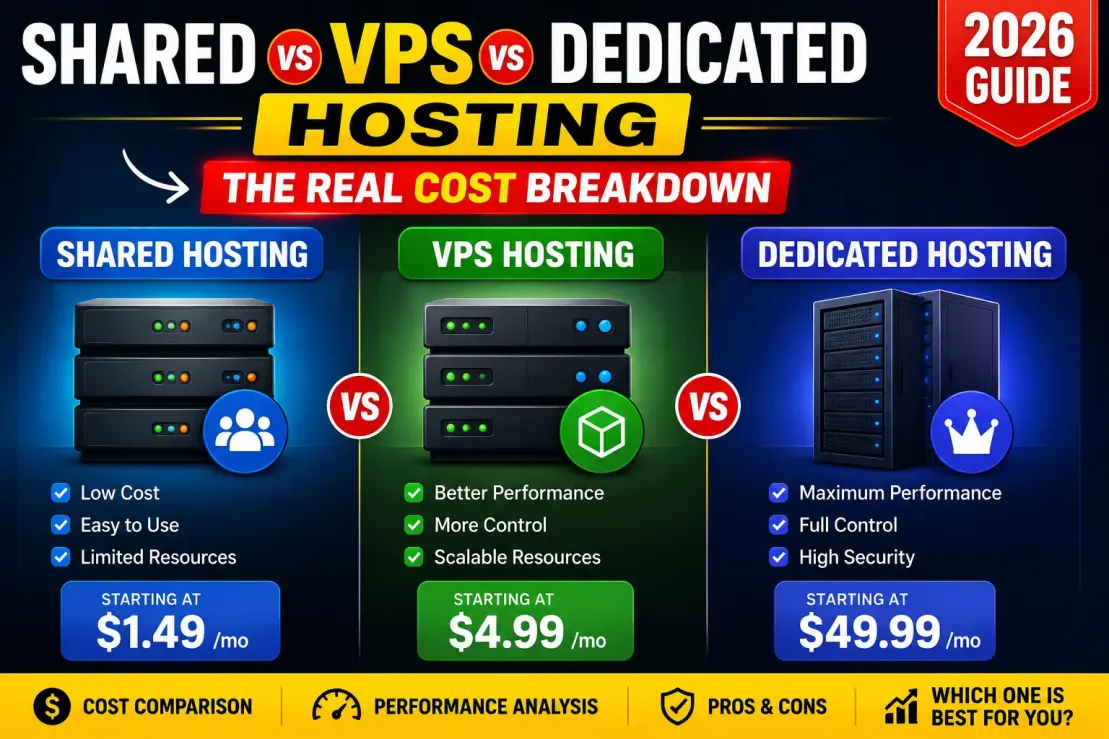
Shared vs VPS vs Dedicated Hosting: The Real Cost Breakdown Most Website Owners Discover Too Late
When people shop for web hosting, they usually begin with a simple question:
"How much does it cost?"
What they often discover months later is that hosting expenses are rarely about the advertised monthly price.
A hosting plan that costs $2.99 per month can become surprisingly expensive when slow performance starts affecting search rankings, visitors abandon pages before they load, or a growing website suddenly exceeds resource limits.
On the opposite side, some website owners spend hundreds of dollars per month on powerful dedicated servers they never truly needed.
The real challenge isn't finding the cheapest hosting. It's understanding what you're actually paying for.
That's where the conversation around Shared Hosting, VPS Hosting, and Dedicated Hosting becomes much more interesting.
Because these aren't simply three price points. They're three fundamentally different approaches to running a website.
And once you understand the real costs—both visible and hidden—the decision becomes far easier.
Understanding What You're Actually Buying
Before comparing prices, it's worth understanding what hosting really is.
Every website lives on a physical server somewhere. That server contains CPU resources, RAM, storage, networking equipment, and operating systems working together to deliver your website whenever someone visits.
The main difference between Shared, VPS, and Dedicated Hosting is how those resources are allocated.
Think of it like housing.
- Shared Hosting is similar to renting a room in a large apartment. (Hostinger)
- VPS Hosting resembles owning a private apartment within a building.
- Dedicated Hosting is comparable to owning the entire house.
The costs increase as control, performance, and exclusivity increase.
What surprises many first-time website owners is how quickly performance considerations become more important than the hosting bill itself.
The Real Cost of Shared Hosting
Shared hosting remains the entry point for most websites.
Bloggers launch on it.
Small business owners start with it.
Students, portfolio sites, local organizations, and hobby projects often use it for years.
The reason is obvious: it's affordable.
| Shared Hosting Cost Factor | Typical Range (2026) |
|---|---|
| Promotional Price | $2 – $6/month |
| Renewal Price | $6 – $15/month |
| Domain Renewal | $10 – $20/year |
| SSL Certificate | Often included |
| Total Annual Cost | $80 – $250 |
At first glance, shared hosting appears unbeatable.
But here's the catch.
Hundreds—or sometimes thousands—of websites may live on the same physical server.
Most of the time that's fine.
Until one website experiences a traffic spike.
Or consumes excessive resources.
Or triggers server slowdowns that affect everyone else sharing the environment.
This is why website owners frequently describe shared hosting as feeling inconsistent.
Get Extra 20% OFF
Launch your website today with ultra-fast, secure & premium hosting from Hostinger. Click to claim your deal!
One day everything is fast.
The next day, page loads seem sluggish despite no changes on your end.
When Shared Hosting Makes Sense
Shared hosting remains an excellent option if:
- You're launching a new blog.
- Traffic stays below 20,000–30,000 monthly visits.
- You operate a local business website.
- Budget is a higher priority than speed.
- You're learning WordPress.
For many websites, especially early-stage projects, shared hosting isn't merely acceptable—it is genuinely the smartest financial decision.
The mistake isn't starting with shared hosting.
The mistake is staying there long after growth demands something more capable.
VPS Hosting: Where Most Growing Websites Eventually Land
There is a reason VPS hosting has become one of the fastest-growing hosting categories over the last decade.
It solves a problem shared hosting cannot.
Predictability.
A VPS (Virtual Private Server) divides a physical server into isolated environments.
While multiple customers still share the underlying hardware, each VPS receives dedicated allocations of CPU, RAM, and storage.
That changes everything.
Instead of competing with hundreds of neighboring websites, your resources are reserved.
| VPS Hosting Cost Factor | Typical Range (2026) |
|---|---|
| Managed VPS | $20 – $100/month |
| Unmanaged VPS | $5 – $50/month |
| Control Panel Licensing | $10 – $40/month |
| Backups | $5 – $20/month |
| Total Annual Cost | $240 – $1,800+ |
The price increase can look significant compared to shared hosting.
Yet many website owners discover the jump is easier to justify than expected.
A business generating leads.
A content site earning advertising revenue.
An e-commerce store processing orders.
These websites often benefit more from stable performance than they lose from the additional hosting expense.
The Hidden VPS Advantage
The biggest VPS benefit isn't raw speed.
It's consistency.
Search engines increasingly reward user experience signals.
Visitors are less patient than they were five years ago.
A website that loads reliably under pressure tends to perform better than one that occasionally struggles.
This is why many experienced developers recommend VPS hosting long before traffic numbers become enormous.
Dedicated Hosting: The Most Powerful—and Most Misunderstood—Option
Dedicated hosting sounds impressive because it is.
You rent an entire physical server.
No neighbors.
Get Extra 20% OFF
Launch your website today with ultra-fast, secure & premium hosting from Hostinger. Click to claim your deal!
No shared resources.
No virtualization layers competing for hardware access.
Everything belongs to your website or applications.
| Dedicated Hosting Cost Factor | Typical Range (2026) |
|---|---|
| Entry-Level Dedicated Server | $80 – $150/month |
| Mid-Range Dedicated Server | $150 – $400/month |
| Enterprise Dedicated Server | $500 – $2,000+/month |
| Management Services | $50 – $300/month |
| Total Annual Cost | $1,000 – $20,000+ |
The interesting reality?
Most websites don't need dedicated hosting.
That's not a criticism of dedicated servers.
It's simply a reflection of how efficient modern VPS platforms have become.
Many websites handling hundreds of thousands of monthly visitors run comfortably on optimized VPS infrastructure.
Dedicated hosting becomes valuable when:
- Traffic volumes are massive.
- Security requirements are strict.
- Applications consume heavy resources.
- Regulatory compliance matters.
- Performance must remain predictable under extreme demand.
Large SaaS platforms, major media publications, financial systems, and enterprise applications often fit this profile.
A personal blog usually does not.
Shared Hosting vs VPS vs Dedicated Hosting Performance Comparison
Price discussions become more meaningful when paired with performance expectations.
| Feature | Shared Hosting | VPS Hosting | Dedicated Hosting |
|---|---|---|---|
| Performance | Basic | High | Very High |
| Traffic Handling | Low-Medium | Medium-High | Very High |
| Server Control | Limited | Moderate-Advanced | Full |
| Security Isolation | Low | Strong | Maximum |
| Scalability | Limited | Excellent | Hardware Dependent |
| Best For | Small Sites | Growing Websites | Enterprise Projects |
One pattern appears repeatedly across the hosting industry.
Most successful websites follow a progression:
Shared → VPS → Dedicated (if ever needed)
Skipping directly to dedicated hosting often means paying for unused capacity.
When Should You Upgrade From Shared Hosting to VPS?
This question appears in hosting forums almost daily.
The answer rarely depends on traffic alone.
More often, website owners should consider upgrading when they notice:
Slower Load Times
Pages begin taking longer to load despite optimization efforts.
Frequent Resource Limit Warnings
Your hosting provider starts notifying you about CPU or memory usage.
Traffic Growth
Consistent growth creates pressure on shared environments.
E-Commerce Expansion
Revenue-generating websites typically benefit from improved reliability.
Multiple Websites
Managing several active websites often stretches shared hosting beyond its comfort zone.
A useful rule of thumb:
If website performance is starting to affect revenue, rankings, or user experience, VPS hosting deserves serious consideration.
Which Hosting Type Is Best for WordPress?
The answer depends on the stage of the website.
For New WordPress Sites
Shared hosting remains practical and cost-effective.
Get Extra 20% OFF
Launch your website today with ultra-fast, secure & premium hosting from Hostinger. Click to claim your deal!
For Growing Content Sites
VPS hosting usually provides the best balance of cost, speed, and flexibility.
For High-Traffic Publishing Platforms
Dedicated hosting—or advanced cloud infrastructure—may become necessary.
Many successful WordPress websites generating significant traffic spend years on VPS environments before needing anything larger.
That reality often surprises beginners who assume "serious" websites require dedicated servers from day one.
The Costs Most Hosting Comparisons Ignore
This is where hosting decisions become genuinely interesting.
The hosting bill itself is only one expense.
There are secondary costs that rarely appear in marketing pages:
- Downtime
- Lost conversions
- Slower search visibility
- Developer troubleshooting time
- Security incidents
- Backup failures
- Migration expenses
- Resource overages
A business losing leads because pages load slowly may spend far more on missed opportunities than on hosting itself.
Viewed this way, hosting becomes less of an expense and more of an operational investment.
The cheapest plan is not always the lowest-cost choice.
Pros and Cons
Shared Hosting
Pros
- Lowest cost
- Beginner-friendly
- Easy setup
- Suitable for small websites
Cons
- Limited resources
- Performance fluctuations
- Reduced scalability
- Less server control
VPS Hosting
Pros
- Dedicated resources
- Strong performance
- Better security isolation
- Excellent scalability
Cons
- Higher cost
- Some technical knowledge required
- Additional management expenses possible
Dedicated Hosting
Pros
- Maximum performance
- Full server control
- Strong security
- Ideal for heavy workloads
Cons
- Highest cost
- Management complexity
- Often excessive for smaller websites
What Most Small Businesses Should Actually Choose
After watching hosting trends evolve for years, one pattern remains remarkably consistent.
Small businesses often underestimate how much performance matters.
At the same time, they overestimate how much server power they need.
For many organizations, a quality VPS plan becomes the sweet spot.
It offers enough performance headroom for growth without introducing the costs and complexity associated with dedicated infrastructure.
Shared hosting remains sensible for new projects.
Dedicated hosting remains valuable for specialized workloads.
But VPS frequently represents the middle ground where cost, reliability, and scalability meet.
Top Suggestions for users
A Final Thought
Hosting discussions often become obsessed with specifications—CPU cores, RAM allocations, storage limits, bandwidth quotas.
Those details matter.
Yet the most successful website owners tend to focus on a simpler question:
"What does my website need right now?"
Not six months from now. Not three years from now.
Right now.
A new blog doesn't need enterprise infrastructure. A growing business shouldn't cling to an overloaded shared server simply because it's cheaper. And a dedicated server shouldn't be purchased for bragging rights.
The smartest hosting choice is usually the one that matches your current reality while leaving enough room for the next stage of growth.
That's where the real cost savings happen—not by paying the least, but by paying for exactly what your website genuinely needs.





💬 Comments (0)
🔒 Please login to post a comment.
Login Now