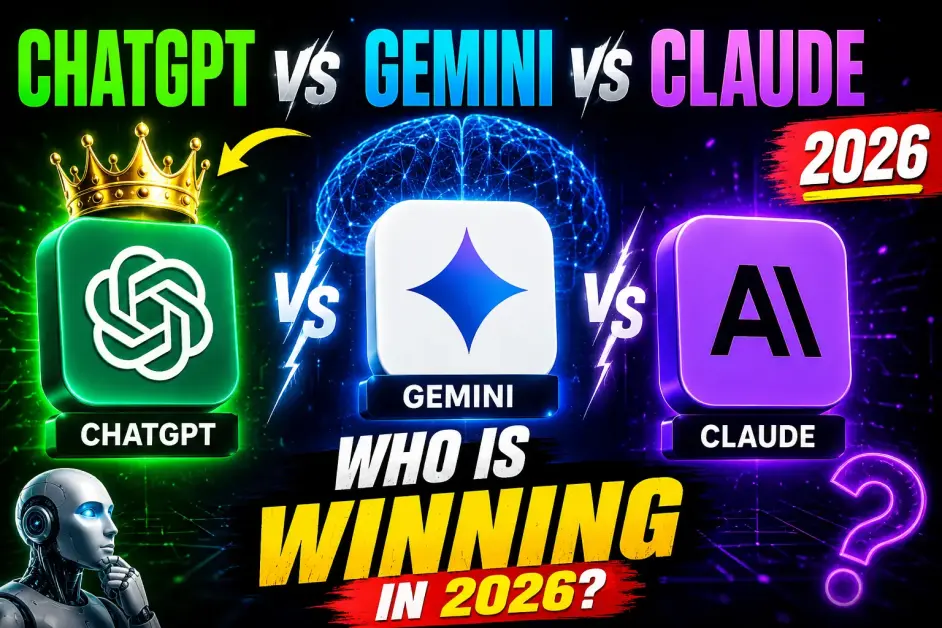
ChatGPT vs Gemini vs Claude: Which AI Is Actually Winning in 2026?
For most of the past decade, technology battles followed a familiar script.
Google versus Apple.
Windows versus macOS.
Android versus iPhone.
But 2026 feels different.
The most important software competition happening right now isn't between smartphones, operating systems, or browsers. It's happening inside a browser tab.
Millions of people now begin their workday by opening an AI assistant before they open email.
Students use AI to understand difficult concepts. Developers use it to debug production code. Marketers use it to brainstorm campaigns. Researchers use it to summarize reports that would otherwise take hours to read.
And increasingly, one question keeps appearing across forums, Reddit discussions, developer communities, boardrooms, and productivity circles:
Which AI is actually the best?
More specifically:
ChatGPT, Gemini, or Claude?
The answer is more complicated than most comparison articles suggest.
Because in 2026, there is no universal winner.
There are only different kinds of strengths.
The interesting story isn't who has the biggest model anymore.
It's who solves real-world problems most effectively.
The AI Race Has Quietly Changed
A year or two ago, most AI discussions focused on model benchmarks.
Who scored highest?
Who solved more math problems?
Who generated better code?
Today, users care about something else.
They care about outcomes.
Can the AI help them finish a project faster?
Can it write something useful?
Can it analyze large documents accurately?
Can it reason through complicated decisions?
Can it become part of a daily workflow?
Those questions have reshaped the competitive landscape.
And that shift explains why all three major players occupy different positions.
Why ChatGPT Still Leads the Conversation
There is a reason people often use the phrase "ask ChatGPT" even when discussing AI in general.
OpenAI achieved something many technology companies struggle to achieve:
They became the default mental model.
That matters.
But branding alone doesn't explain ChatGPT's position.
The platform has evolved into an increasingly complete ecosystem.
Users can write.
Research.
Analyze data.
Generate images.
Build custom GPTs.
Use advanced reasoning models.
Connect workflows.
Handle documents.
Manage projects.
What makes ChatGPT powerful in 2026 is not merely intelligence.
It's versatility.
Many competing tools excel in one area.
ChatGPT performs exceptionally well across almost all categories.
That balance makes it difficult to replace.
Where ChatGPT Excels
- Multi-purpose productivity
- Coding assistance
- Research workflows
- Business use cases
- Creative content generation
- AI image generation
- Custom assistants
- Knowledge work
Where ChatGPT Still Has Challenges
- Some enterprise integrations remain evolving
- Real-time web experiences vary depending on usage mode
- Advanced features may overwhelm casual users
Still, for most people, ChatGPT offers the broadest capability package available today.
Gemini's Biggest Advantage Isn't Intelligence
Google's Gemini often gets judged unfairly.
Many users compare Gemini directly against ChatGPT and stop there.
That misses Gemini's strongest advantage.
Gemini isn't trying to become a standalone AI destination.
It's trying to become the intelligence layer behind Google's ecosystem.
That's a completely different strategy.
Think about where people already spend time:
- Gmail
- Google Docs
- Google Sheets
- Android
- Chrome
- Google Search
- Google Drive
- Google Workspace
Google doesn't need users to abandon those products.
Instead, Gemini can enhance them.
That integration strategy may become one of the most important advantages in the long term.
For professionals already embedded in Google Workspace, Gemini often feels less like another tool and more like a built-in assistant.
ALSO READ: Future of Quantum Computing
Get Extra 20% OFF
Launch your website today with ultra-fast, secure & premium hosting from Hostinger. Click to claim your deal!
Claude: The Quiet Favorite Among Power Users
Claude occupies an interesting position.
It rarely generates the same level of public attention as ChatGPT.
It doesn't enjoy Google's ecosystem advantages.
Yet among writers, analysts, researchers, and many developers, Claude has developed a remarkably loyal following.
Why?
Because Claude often feels thoughtful.
That may sound subjective.
But experienced users frequently describe Claude as producing responses that feel more structured, nuanced, and context-aware during complex discussions.
Long-form writing is where Claude frequently shines.
Large documents.
Policy reviews.
Strategic analysis.
Research synthesis.
Complex reasoning.
These tasks play directly into Claude's strengths.
Many users report that Claude feels less eager to answer quickly and more willing to explore complexity.
That distinction matters for serious knowledge work.
The Real Test: Which AI Writes Better?
Writing quality remains one of the most debated areas.
The answer depends heavily on the type of writing.
Claude often produces richer prose.
ChatGPT usually delivers stronger adaptability.
Gemini increasingly benefits from direct integration with productivity tools.
No single winner exists here.
The best choice depends on what you're writing.
Developers Have Become Much More Demanding
Coding was once viewed as an AI showcase feature.
Now it's a baseline expectation.
Professional developers care about different things:
- Debugging quality
- Architecture suggestions
- Refactoring ability
- Context retention
- Framework understanding
- Documentation analysis
ChatGPT remains exceptionally strong for general coding.
Claude has become a favorite for larger codebases and architectural discussions.
Gemini continues improving rapidly, particularly for developers working inside Google's ecosystem.
The gap between these platforms has narrowed significantly.
The winner often comes down to workflow preference rather than raw capability.
The Hidden Battle Nobody Talks About
The biggest AI competition in 2026 isn't intelligence.
It's trust.
Users increasingly depend on AI systems for meaningful decisions.
Business decisions.
Research decisions.
Learning decisions.
Financial planning.
Career development.
As AI becomes more influential, reliability matters more than impressive demos.
The future winners won't necessarily be the models that generate the most impressive benchmark scores.
They will be the systems people trust repeatedly.
That's a much harder challenge.
ALSO READ: Categories vs Tags in wordpress how they work
Pros and Cons
ChatGPT
Pros
- Best all-around platform
- Excellent ecosystem
- Strong research capabilities
- Advanced multimodal features
- Powerful custom GPT ecosystem
Cons
- Feature complexity can overwhelm beginners
- Premium features often provide the best experience
Gemini
Pros
- Deep Google integration
- Excellent productivity workflows
- Strong search ecosystem
- Convenient for Workspace users
Cons
- Experience varies depending on Google products used
- Less cohesive feeling than dedicated AI-first platforms
Claude
Pros
- Exceptional long-form reasoning
- Strong writing quality
- Excellent context handling
- Popular among researchers and analysts
Cons
- Smaller ecosystem
- Fewer surrounding platform features
So Which AI Should You Choose?
This is where most comparison articles oversimplify.
Different users need different answers.
Choose ChatGPT If:
- You want the best overall AI experience
- You create content regularly
- You need coding assistance
- You want one AI for multiple tasks
Choose Gemini If:
- You live inside Google Workspace
- You use Gmail and Docs extensively
- You prefer Google's ecosystem
Choose Claude If:
- You write long reports
- You perform deep research
- You analyze large documents
- You prioritize nuanced reasoning
Comparison Table
| Feature | ChatGPT | Gemini | Claude |
|---|---|---|---|
| Developer | OpenAI | Anthropic | |
| Best For | All-Purpose AI | Google Ecosystem | Research & Analysis |
| Content Writing | ⭐⭐⭐⭐⭐ | ⭐⭐⭐⭐ | ⭐⭐⭐⭐⭐ |
| Blog Writing | ⭐⭐⭐⭐⭐ | ⭐⭐⭐⭐ | ⭐⭐⭐⭐⭐ |
| SEO Content | ⭐⭐⭐⭐⭐ | ⭐⭐⭐⭐ | ⭐⭐⭐⭐⭐ |
| Coding | ⭐⭐⭐⭐⭐ | ⭐⭐⭐⭐ | ⭐⭐⭐⭐⭐ |
| Debugging | ⭐⭐⭐⭐⭐ | ⭐⭐⭐⭐ | ⭐⭐⭐⭐⭐ |
| Research | ⭐⭐⭐⭐⭐ | ⭐⭐⭐⭐⭐ | ⭐⭐⭐⭐⭐ |
| Long Document Analysis | ⭐⭐⭐⭐⭐ | ⭐⭐⭐⭐ | ⭐⭐⭐⭐⭐+ |
| Reasoning | ⭐⭐⭐⭐⭐ | ⭐⭐⭐⭐⭐ | ⭐⭐⭐⭐⭐+ |
| Image Generation | ⭐⭐⭐⭐⭐ | ⭐⭐⭐⭐ | ❌ |
| Image Editing | ⭐⭐⭐⭐⭐ | ⭐⭐⭐ | ❌ |
| Google Workspace Integration | ⭐⭐ | ⭐⭐⭐⭐⭐ | ⭐⭐ |
| Gmail & Docs Support | Limited | Excellent | Limited |
| Custom AI Assistants | GPTs | Limited | Projects |
| File Upload Analysis | Excellent | Very Good | Excellent |
| Student Use | ⭐⭐⭐⭐⭐ | ⭐⭐⭐⭐⭐ | ⭐⭐⭐⭐ |
| Business Use | ⭐⭐⭐⭐⭐ | ⭐⭐⭐⭐ | ⭐⭐⭐⭐⭐ |
| Ease of Use | ⭐⭐⭐⭐⭐ | ⭐⭐⭐⭐ | ⭐⭐⭐⭐ |
| Free Plan | Good | Excellent | Good |
| Paid Plan Value | Excellent | Very Good | Very Good |
| Use Case | Winner |
|---|---|
| Best Overall AI | 🏆 ChatGPT |
| Best for Bloggers | 🏆 ChatGPT |
| Best for SEO Content | 🏆 ChatGPT |
| Best for Coding | 🏆 ChatGPT |
| Best for Research | 🏆 Claude |
| Best for Long Documents | 🏆 Claude |
| Best for Students | 🏆 ChatGPT |
| Best for Google Users | 🏆 Gemini |
| Best Free AI | 🏆 Gemini |
| Best Paid AI | 🏆 ChatGPT |
| Best for Business Work | 🏆 ChatGPT |
| Best for Deep Reasoning | 🏆 Claude |
Final Thoughts
The most surprising aspect of the AI race in 2026 is that it no longer feels like a race toward a finish line.
It feels more like the emergence of three distinct philosophies.
ChatGPT aims to become a universal digital companion.
Gemini seeks to make Google's ecosystem smarter.
Claude focuses on thoughtful reasoning and deep intellectual work.
Each platform reflects a different vision of how humans and AI will collaborate.
And perhaps that's why declaring a single winner feels increasingly difficult.
The real winner may ultimately be the user—because for the first time in modern software history, the competition is pushing all major AI platforms to improve at a pace that would have seemed impossible only a few years ago.





💬 Comments (0)
🔒 Please login to post a comment.
Login Now